This One Investing Lesson Can Change Long-Term Returns
A simple 20-year comparison shows why staying invested matters more than trying to pick the perfect moment to enter the market.
 Emily Turner
One of the most enduring lessons in investing is also one of the hardest to follow: time in the market matters far more than attempts to perfectly time market entry.
A widely cited long-term comparison illustrates this principle with striking clarity. The chart tracks four hypothetical investors who each invested $2,000 per year over a 20-year period, using different approaches to market timing.
Four investors, four outcomes
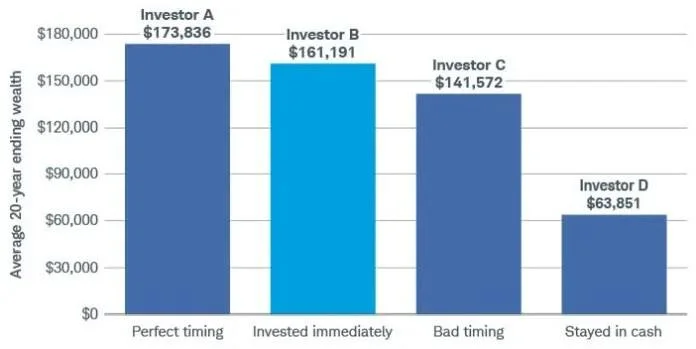 Investor A — “Perfect timing” ($173,836)
This investor represents a theoretical best case: investing every year at the market’s lowest point. Even with flawless timing, the final result was only modestly better than that of a disciplined investor who simply invested consistently.
Investor B — “Invested immediately” ($161,191)
This approach reflects regular investing without trying to predict market movements. Funds were invested as soon as they became available. The outcome came remarkably close to the result achieved by perfect timing — without the need for forecasts or precision.
Investor C — “Bad timing” ($141,572)
This investor consistently entered the market at unfavourable moments, often near market peaks. Despite poor timing, long-term exposure to market growth still produced a significantly higher result than holding cash.
Investor D — “Stayed in cash” ($63,851)
By waiting for the “right” moment and keeping money in cash-like instruments such as deposits or short-term bills, this investor saw the weakest outcome. Inflation and missed growth opportunities steadily eroded purchasing power.
The key takeaway
The comparison highlights a powerful reality: markets reward participation over prediction. Even imperfect investing decisions can outperform inactivity over long horizons, while waiting on the sidelines often carries its own hidden risks.
Compounding works best with time. The longer capital remains invested, the more growth builds upon itself — something that market timing strategies frequently disrupt.
-
 Trying to “Buy the Dip”? These S&P 500 Numbers Tell a Different StoryInvesting Strategies
 -
SGOV ETF Explained: How Ultra-Short U.S. Treasuries Work as a Cash AlternativeInvesting Strategies
-
How Many Stocks Should You Hold in a Portfolio?Investing Strategies
-
Ten Megatrends Investors Are Watching for the Next DecadeInvesting Strategies
-
Top Dividend Stocks for 2026: High Yields, but at What Cost?Investing Strategies