DXY Weakens for Second Straight Week, Boosting Risk Assets
The US dollar weakens for a second week as a softer Fed tone boosts expectations of deeper cuts and supports risk assets.
 Amelia Hayes
The US dollar continued to drift lower on Thursday, falling against the euro, sterling and the yen as markets reassessed the Federal Reserve’s policy outlook following yesterday’s rate decision. The ICE Dollar Index (DXY) was down 0.31% by mid-day, while the broader WSJ Dollar Index slipped 0.09%.
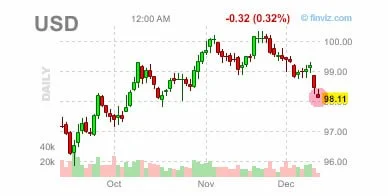
During Wednesday’s session, the DXY fell 0.4% after the Federal Reserve cut rates by 25 basis points to a range of 3.5–3.75%. While the move was widely expected, Chair Jerome Powell’s remarks proved notably softer than anticipated — a tone traders on the desk described as “cautiously concerned”.
Powell highlighted growing worries about labour market conditions and mentioned “substantial downside risks,” which markets interpreted as a signal that the Fed could ease more aggressively if data weakens. The median projection still implies only one 25 bps cut in 2026, though investors doubt this will hold.
Euro, Sterling and Yen Push Higher
The euro traded at $1.1720 by 15:24 MSK, up from $1.1697 at yesterday’s close. Sterling followed, edging to $1.3391. Against the yen, the dollar declined 0.2% to ¥155.65.
Next week brings the final policy meetings of the year from both the European Central Bank and the Bank of Japan. ECB President Christine Lagarde signalled that the eurozone’s updated forecasts may be more optimistic than previous rounds — giving the currency an additional lift during the early London session.
Indian Rupee Hits Record Low
The Indian rupee weakened beyond 90 per dollar, marking a historic low. The currency has fallen more than 5% this year amid US import tariffs on Indian goods. FX traders expect volatility to remain elevated heading into year-end.
Two Weeks of Dollar Declines: A Risk-On Signal
The dollar has now fallen for two consecutive weeks — a pattern that, historically, has been bullish for risk assets such as equities and cryptocurrencies. Softer US yields and a more dovish interpretation of Powell’s comments have encouraged investors to rotate selectively into higher-beta assets.
As traders in London noted this morning: “The market is starting to believe the Fed may not wait as long as its projections suggest.” That shift has put pressure on the dollar, but it has also revived appetite for risk ahead of a packed December macro calendar.