Markets Face Turbulence as Trade and Fed Risks Collide
U.S. equity futures trade higher as investors navigate elevated volatility, trade tensions, and key macro data ahead of the Federal Reserve decision.
 Daniel Brooks
U.S. markets are entering a zone of elevated turbulence as investors balance positive momentum in equity futures against rising geopolitical, trade and macroeconomic risks.
Futures are trading modestly higher, with the overall risk balance leaning positive — though volatility remains elevated.
Trade and Political Risks in Focus
Attention is centred on an upcoming speech by former President Donald Trump, with investors looking for guidance on the future direction of U.S. trade policy. Trump has threatened to raise tariffs on South Korean goods to 25%.
In response, South Korea’s ruling party signalled readiness to accelerate the approval of a trade agreement with Washington, underscoring the growing importance of trade diplomacy in the current market environment.
Healthcare Sector Under Pressure
U.S. healthcare stocks came under sharp pressure after the Trump administration proposed only a minimal increase in reimbursement rates for Medicare Advantage insurers for 2027.
The announcement triggered a sell-off across parts of the sector, reflecting investor sensitivity to policy-driven earnings risks.
Key Macro Data Today
The main macro release of the day is the Conference Board Consumer Confidence Index for January. The consensus forecast stands at 91, up from 89.1 in December, making it a key gauge of household sentiment and consumption trends.
Also due is the Richmond Fed Manufacturing Index for January, with expectations at -5 versus -7 previously. A negative reading would continue to signal ongoing weakness in the industrial sector.
Market Performance Snapshot
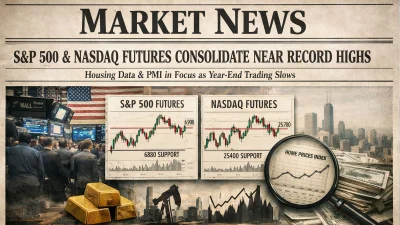
During the previous session, the S&P 500 and Nasdaq closed higher. The S&P 500 moved closer to record highs, reaching around 6,950, while the Nasdaq finished just below 25,800 after testing a downward trend line.
Today, S&P 500 and Nasdaq futures are extending gains. The S&P 500 remains within a local uptrend, approaching record levels, with 6,900 acting as key support. Nasdaq futures are consolidating near 26,000, with support seen around 25,500.
What’s Driving Markets This Week
- January consumer confidence data
- ADP employment report
- S&P CoreLogic Case-Shiller Composite-20 home price index
- Federal Reserve interest rate decision
- Earnings reports from major technology companies
Safe-haven demand remains elevated, with gold breaking above $5,000 per ounce for the first time amid geopolitical tensions, strong demand for defensive assets and a weaker U.S. dollar.
The U.S. Treasury will also auction 5-year notes, adding another focal point for rates markets.
Sector Performance
Cyclical sectors showed mixed performance. Financials and materials led gains, while aerospace & defence and consumer discretionary lagged.
Growth sectors were mixed, with strength in cloud computing and communications services offset by weakness in semiconductors and cannabis-related names.
Defensive sectors posted mostly positive performance, led by utilities, while consumer staples ended the session slightly lower.
Cross-Asset View
Crude oil is testing the lower boundary of a short-term rising channel near $60. U.S. Treasury yields are trading around 4.22%, approaching a medium-term uptrend line from November.
The VIX remains near the lower edge of a rising channel around 16, signalling contained but fragile risk sentiment. Gold continues to trade near record highs, holding around 5,070 within a broader uptrend.
Overall, markets remain constructive — but fragile. The combination of record equity levels, policy uncertainty and key macro events suggests volatility is likely to persist.
-
 US Stock Futures Consolidate as Investors Await Jobless ClaimsStocks
 -
Trump’s Davos Speech Sets the Tone as Markets Brace for Trade and Geopolitical RisksStocks
-
Risk Appetite Stays Cautious as Yen Volatility and Shutdown Fears ResurfaceStocks
-
S&P 500 and Nasdaq Futures Consolidate Near Record Highs as Volatility Stays SubduedStocks
-
Markets Open Week on Cautious Optimism Ahead of PCEStocks
-
Wall Street Futures Pause Near Highs Ahead of US Housing and PMI DataStocks