Wall Street Futures Pause Near Highs Ahead of US Housing and PMI Data
US stock futures trade sideways near record levels as investors await housing price data and Chicago PMI, with volumes thinning into year-end.
 Daniel Brooks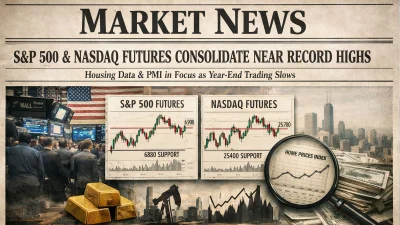
US equity futures are showing a consolidation pattern on the final stretch into year-end, with investors shifting focus to incoming housing and activity data.
Previous session recap
The prior trading session ended modestly lower for major US indices. The S&P 500 closed near 6,900, remaining firmly within all-time high territory. The Nasdaq Composite posted a shallow pullback, retreating from a local descending trendline originating from the October peak and finishing the session near the 25,000 level.
What futures are signalling today
In early trading, S&P 500 futures continue to consolidate near record highs, holding close to the 6,900 area. The nearest technical support is seen around 6,880, a level that has attracted buyers during recent intraday pullbacks.
Nasdaq futures, after a brief rejection near 25,900, are stabilising around 25,700. Initial support is located near 25,400, where dip-buying activity has previously emerged.
Key drivers in focus
Later today, markets will digest the release of the S&P/Case-Shiller Composite-20 Home Price Index for October (seasonally unadjusted), offering a fresh snapshot of US housing price dynamics.
Investors will also monitor the Chicago PMI for December, a regional gauge of business activity that often shapes short-term sentiment into month-end.
On a broader basis, US equities are underperforming several international and emerging markets on a year-to-date basis. Even so, gains in the S&P 500 remain substantial when viewed through a long-term historical lens.
Additional market drivers
Markets are also awaiting the release of the Chicago PMI for December, with consensus expectations pointing to a rebound toward 41 after November’s sharp drop to 36.3. A stronger-than-expected reading would support the view that the manufacturing cycle may be finding a bottom, while weaker data would reinforce concerns about ongoing stagnation in the industrial sector.
In parallel, the Dallas Fed Services Index is expected to remain in negative territory at -2, compared with -2.3 previously. A continued contraction would signal persistent pressure across parts of the US services economy.
Geopolitical developments remain in focus, with heightened attention on the situation in Ukraine amid reports of renewed escalation, as well as military drills involving China and Taiwan. These dynamics continue to provide underlying support for oil prices and energy-related equities.
Precious metals are likely to remain among the most volatile asset classes. Both gold and silver have already begun to recover part of the previous session’s losses in early trading.
Overall, the risk balance remains neutral amid low volatility, with the S&P 500 expected to trade within a 6,880–6,940 range in the near term.
Cross-asset and macro signals
Gold and gold mining equities retreated after recent record highs, following higher margin requirements announced by the CME Group and a wave of profit-taking. The pullback has so far remained orderly.
Crude oil continues to trade within a short-term upward channel, hovering near the $58 area. US Treasury yields are consolidating above the 4.1% support zone, while the VIX volatility index has broken above a local downtrend and is holding above 14.
Notably, trading volumes across major indices are declining into the final session of the year, reinforcing the current range-bound market behaviour.
Sector performance
- Cyclicals: Mostly lower, with consumer discretionary (XLY) and materials (XLB) leading declines.
- Energy & Real Estate: XLE and XLRE finished modestly higher.
- Growth sectors: Under pressure, with MJ, TAN, IBB, and SKYY among the weakest.
- Defensives: Mixed performance; utilities (XLU) slightly outperformed, while healthcare (XLV) edged lower.
From an editorial perspective, the significance lies less in directional conviction and more in positioning — markets appear to be pausing, not reversing, as liquidity thins and macro signals take centre stage.
-
 S&P 500 and Nasdaq Futures Consolidate Near Record Highs as Volatility Stays SubduedStocks
 -
US Stock Futures Consolidate as Investors Await Jobless ClaimsStocks
-
S&P 500 Futures Stabilize Above 6900 as Year-End Volumes ThinStocks
-
S&P 500 and Nasdaq Futures Trade Sideways as PMI and Labor Data Take Center StageStocks
-
U.S. Index Futures Edge Lower Ahead of Key Fed SignalsStocks
-
Markets Open Week on Cautious Optimism Ahead of PCEStocks