Markets on Edge as Reports Signal Imminent U.S.–Iran Military Escalation
Reports from regional and international media point to escalating preparations for a potential US strike on Iran, raising risks of market volatility, oil price spikes, and broader risk-off moves.
 Olivia Carter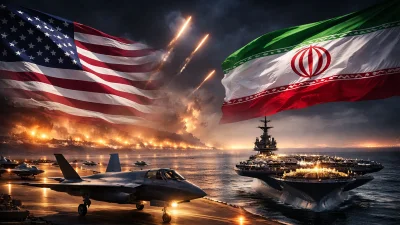
Geopolitical tensions surrounding Iran are rapidly escalating, with multiple media reports suggesting that the United States and its allies are preparing for a possible military operation.
According to Israeli media, US forces are expected to complete operational and logistical preparations over the coming weekend, amid growing speculation that a decision on military action against Iran may already have been made.
Signals of Imminent Escalation
Iraqi outlet Baghdad Today reported that Qatari officials believe a US strike on Iran could begin before the end of next week. At the same time, Iranian media claim Tehran has sent a formal warning to the United Nations, cautioning that the region is on the brink of a broader war.
Satellite imagery has reportedly confirmed the presence of US F-35 fighter jets at the Muwaffaq Salti Air Base in Jordan — less than 900 kilometers from Iran’s borders. Iranian outlets view the deployment as a clear indicator of offensive readiness.
Israeli Channel 12 reported that the Israeli Air Force is preparing for a “miscalculation scenario,” under which Iran could launch a preemptive strike on Israel based on the assumption that US military action is inevitable.
Regional and Allied Involvement
Iranian media have also claimed that the United Kingdom and the United Arab Emirates have urged Washington to proceed with military action. The UAE is reported to have transferred part of its THAAD missile defense systems to Israel.
Israeli Channel 13 stated that senior Israel Defense Forces officials told US Central Command head Admiral Brad Cooper — who met with Prime Minister Benjamin Netanyahu over the weekend — that any US strike should target not only specific military sites but also Iranian state infrastructure.
In response, Iran has warned that if US forces enter its territory, the aircraft carrier USS Abraham Lincoln and its entire strike group would become legitimate targets for hypersonic missile attacks.
Military Movements and Defensive Measures
Turkish media report that Ankara is developing an emergency contingency plan in case of a direct military conflict between the US and Iran.
Iran has closed its airspace to drones and private aircraft for three months, a move widely interpreted as preparation for potential hostilities.
Meanwhile, an aircraft carrier strike group led by the nuclear-powered USS Abraham Lincoln has arrived in the Middle East and is operating near Iran, according to Israeli Channel 13. US officials have also pledged to reinforce regional air defenses, with additional THAAD missile defense batteries expected to arrive in the coming days.
Market Implications
For financial markets, the implications are significant. Any transition from rhetoric to direct military action would likely trigger sharp risk-off moves across global assets.
Equities could come under pressure, particularly in regions exposed to energy price shocks, while safe-haven assets may see inflows. Oil markets are especially vulnerable: a conflict involving Iran would raise concerns over supply disruptions in the Strait of Hormuz, potentially driving crude prices sharply higher.
Investors are increasingly alert to the possibility that geopolitics — rather than macro data — could become the dominant driver of market volatility in the days ahead.
-
 Europol Warns of Rising Human–Robot Conflict in Europe by 2035Geopolitics & Regulation
 -
Why Venezuela Matters: Oil, Power and Global Energy MarketsGeopolitics & Regulation
-
Greenland Annexation and Statehood Act Filed in U.S. CongressGeopolitics & Regulation
-
Trump’s Greenland Tariff Threat Sends U.S. Futures Down, Europe Sells OffGeopolitics & Regulation
-
Germany Urged to Repatriate Gold Held in the US Over Policy RisksGeopolitics & Regulation
-
America’s Energy Infrastructure May Not Withstand the AI SurgeGeopolitics & Regulation