Europol Warns of Rising Human–Robot Conflict in Europe by 2035
Europol warns that rising automation, drones and AI-driven robots could fuel social tension, sabotage and new forms of crime in Europe by 2035.
 Olivia Carter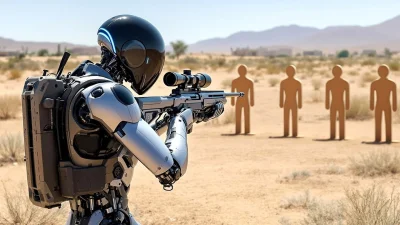
European law enforcement agencies are preparing for a future in which robots and autonomous systems may become not only tools, but sources of conflict. According to a new foresight report by Europol’s Innovation Lab, growing reliance on drones, AI-powered robots and unmanned systems could fuel social tensions, criminal misuse and even violence involving machines across Europe by 2035.
The report, titled “The Unmanned Future(s)”, does not predict a literal war between humans and robots. Instead, it outlines a more complex and realistic risk: conflicts around robots — including sabotage, vandalism, criminal exploitation and public backlash — as automation becomes deeply embedded in everyday life.
From tools to targets
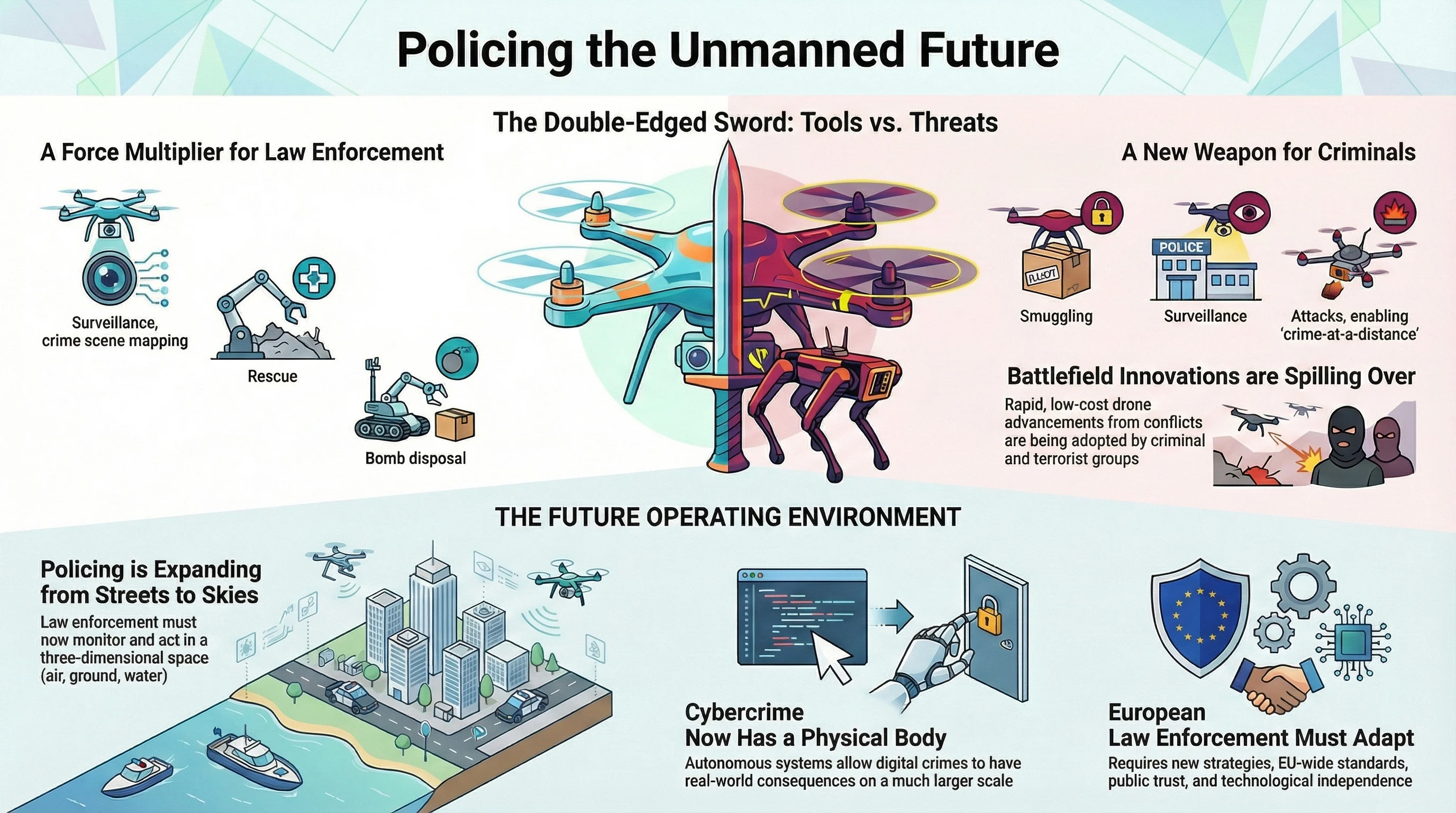
Unmanned systems are already widely used by European law enforcement for surveillance, crime scene mapping, search and rescue operations, and explosive ordnance disposal. These technologies act as force multipliers, allowing police to operate more safely and efficiently.
At the same time, Europol warns that the very same systems are increasingly becoming targets themselves. As robots move into public spaces, infrastructure and private environments, they may attract hostility driven by job displacement, privacy concerns or political protest.
The report highlights early signs of what it describes as “bot-bashing” — deliberate damage, sabotage or arson attacks against robots and automated infrastructure — alongside crimes committed using robots, such as smuggling, remote surveillance and attacks carried out at a distance.
Crime moves into three dimensions
Europol argues that Europe’s security environment is shifting from traditional two-dimensional policing to a fully three-dimensional operating space, spanning air, land, sea and even underwater domains.
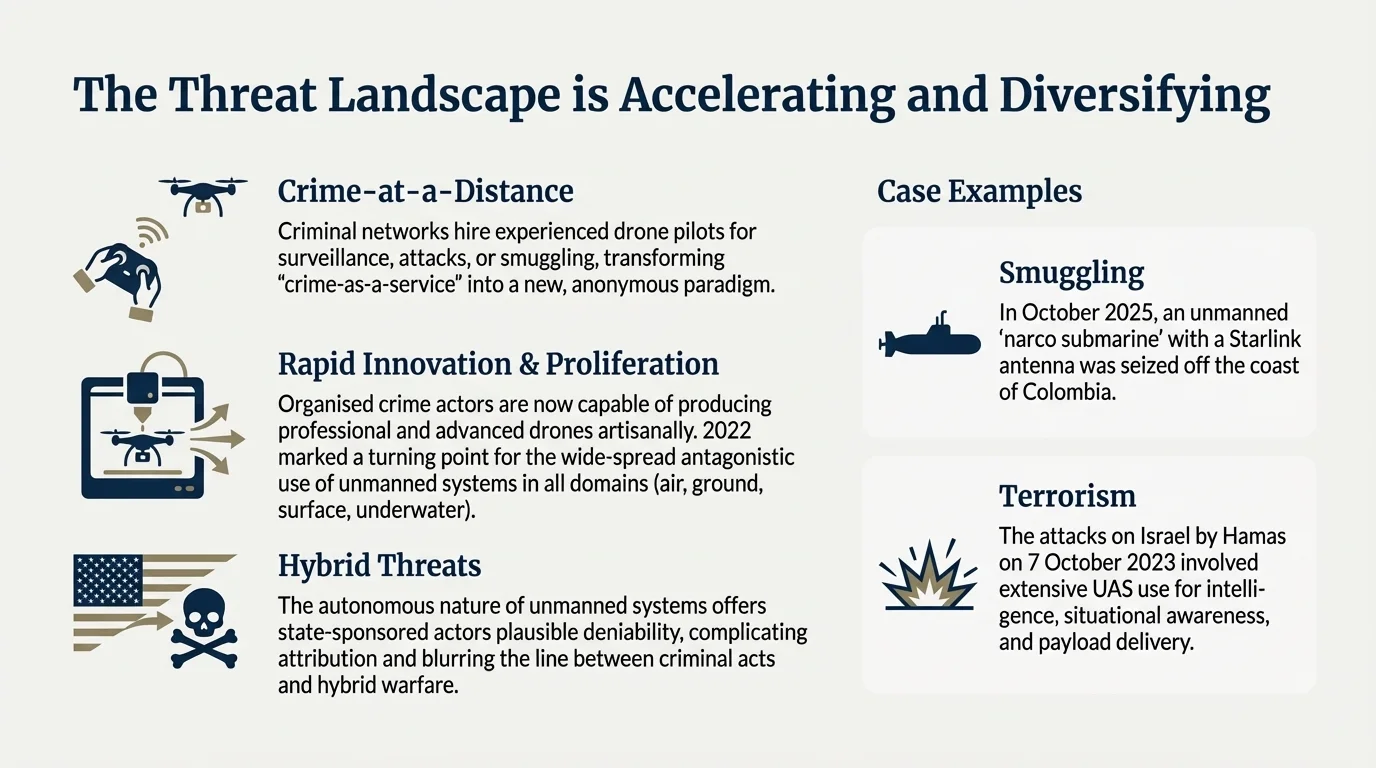
Drones, autonomous ground vehicles and unmanned maritime systems allow criminals to bypass traditional routes, borders and detection methods. This enables what Europol calls “crime-at-a-distance”, where offenders can operate remotely with greater anonymity and deniability.
The challenge for police, the report notes, is no longer just stopping individual devices, but distinguishing malicious activity within dense volumes of legitimate autonomous traffic.
War-driven innovation spills into society
The report repeatedly points to recent military conflicts — particularly Russia’s war against Ukraine — as accelerators of drone innovation that are now spilling into civilian and criminal use.
Low-cost, AI-assisted drones, resistant to jamming and often assembled using commercially available components and 3D printing, are becoming accessible far beyond the battlefield. Europol warns that such technologies could be repurposed by organised crime or extremist groups, raising new risks for internal security.
Cybercrime gains a physical body
Another key concern outlined in the report is the convergence of cybercrime and physical harm. Autonomous systems allow digital attacks to produce real-world consequences — from infrastructure sabotage to surveillance, coercion and physical intimidation.
This shift complicates attribution and accountability. When an autonomous system causes harm, responsibility may be spread across owners, developers, operators or remote controllers located in different jurisdictions.
Public trust and regulation under pressure
Europol stresses that public trust will be a decisive factor in how successfully European societies navigate this transition. Previous deployments of police robots and drones have already triggered backlash over fears of surveillance, dehumanised policing and loss of privacy.
Regulatory frameworks, the report argues, are struggling to keep pace with technological change — particularly in areas such as autonomous decision-making, liability and counter-drone powers for law enforcement.
Without updated rules and clear safeguards, Europol warns that both public acceptance and operational effectiveness could erode.
No “robot war” — but real conflict risks
While Europol avoids sensational language, its conclusion is clear: the rapid expansion of robots and unmanned systems into European society will reshape crime, policing and social relations.
“Human–robot conflict” in this context does not mean machines turning against people, but rather people clashing with the systems that increasingly shape their work, security and daily lives.
Preparing for that future, Europol concludes, will require new policing strategies, EU-wide standards, technological independence and sustained public dialogue — long before tensions escalate.
-
 Why Venezuela Matters: Oil, Power and Global Energy MarketsGeopolitics & Regulation
 -
Greenland Annexation and Statehood Act Filed in U.S. CongressGeopolitics & Regulation
-
Trump’s Greenland Tariff Threat Sends U.S. Futures Down, Europe Sells OffGeopolitics & Regulation
-
America’s Energy Infrastructure May Not Withstand the AI SurgeGeopolitics & Regulation
-
Bank of Russia Unveils New Framework for Cryptocurrency RegulationGeopolitics & Regulation
-
After Maduro Bet Windfall, U.S. Congress Targets Insider Trading on Prediction MarketsGeopolitics & Regulation