India and EU Reach Historic Trade Deal After 20 Years of Talks
India and the European Union have reached a landmark trade agreement after two decades of negotiations, covering nearly a third of global trade and signalling a strategic geopolitical shift.
 Olivia Carter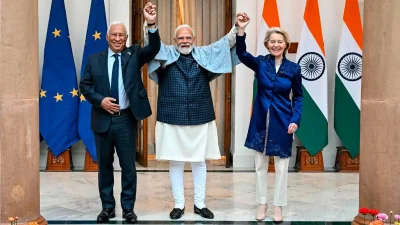
India and the European Union have reached a historic agreement on a comprehensive trade deal, concluding nearly 20 years of negotiations. Indian Prime Minister Narendra Modi described the pact as the “mother of all agreements,” highlighting its scale and strategic significance.
The agreement is expected to be formally signed following legal review and ratification by the European Parliament.
Scope and Economic Impact
The India–EU trade agreement covers economies that together account for roughly 25% of global GDP and close to one-third of world trade. It introduces sweeping tariff reductions on industrial and consumer goods, while largely excluding sensitive agricultural sectors.
According to official projections, the deal could increase India’s exports to the EU by around $50 billion by 2031, driven primarily by pharmaceuticals, textiles, chemicals and engineering goods.
For the EU, the agreement opens deeper access to one of the world’s fastest-growing major markets, with a population exceeding 1.4 billion.
Key Tariff Reductions
The agreement предусматривает масштабное снижение пошлин:
- Tariffs will be reduced on 96.6% of goods exported from the EU to India
- Automotive duties will be gradually cut from 110% to 10%
- Machinery tariffs will be lowered by up to 44%
- Chemicals duties reduced by up to 22%
- Pharmaceutical tariffs cut by approximately 11%
Luxury and consumer goods also benefit, with wine tariffs reduced from 150% to 20%, olive oil duties falling from 45% to zero over five years, and the removal of high tariffs on bread and confectionery products.
The European Commission estimates that tariff cuts alone could save EU exporters around €4 billion per year.
Services, SMEs and Sustainability
European service providers will gain privileged access to India’s market in key sectors, including financial services and maritime transport.
The agreement also introduces dedicated support mechanisms for small and medium-sized enterprises, including contact points, regulatory assistance and reduced non-tariff barriers.
In parallel, the EU is expected to provide up to €500 million over the next two years to support India’s efforts to reduce greenhouse gas emissions and advance climate-related initiatives.
Strategic and Geopolitical Dimensions
Beyond trade, the deal reflects a broader strategic realignment. India and the EU have agreed to deepen cooperation in security and defence, including the expansion of joint defence manufacturing.
This shift underscores India’s gradual geopolitical pivot toward closer engagement with Western partners amid a changing global order.
While the agreement’s economic benefits will unfold over time, its immediate significance lies in the signal it sends: India and the EU are positioning themselves as long-term strategic partners in trade, technology and security.
-
 Europol Warns of Rising Human–Robot Conflict in Europe by 2035Geopolitics & Regulation
 -
Why Venezuela Matters: Oil, Power and Global Energy MarketsGeopolitics & Regulation
-
Trump’s Greenland Tariff Threat Sends U.S. Futures Down, Europe Sells OffGeopolitics & Regulation
-
Greenland Annexation and Statehood Act Filed in U.S. CongressGeopolitics & Regulation
-
Bank of Russia Unveils New Framework for Cryptocurrency RegulationGeopolitics & Regulation
-
America’s Energy Infrastructure May Not Withstand the AI SurgeGeopolitics & Regulation