Why Most Investors Fail to Beat the S&P 500
On average, fewer than half of S&P 500 companies outperform the index each year. Here’s why that makes beating the market statistically difficult.
 Emily Turner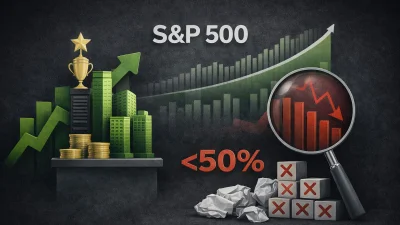
From an educational perspective, the most important lesson about markets is also the simplest: beating the index is mathematically harder than most investors realise.
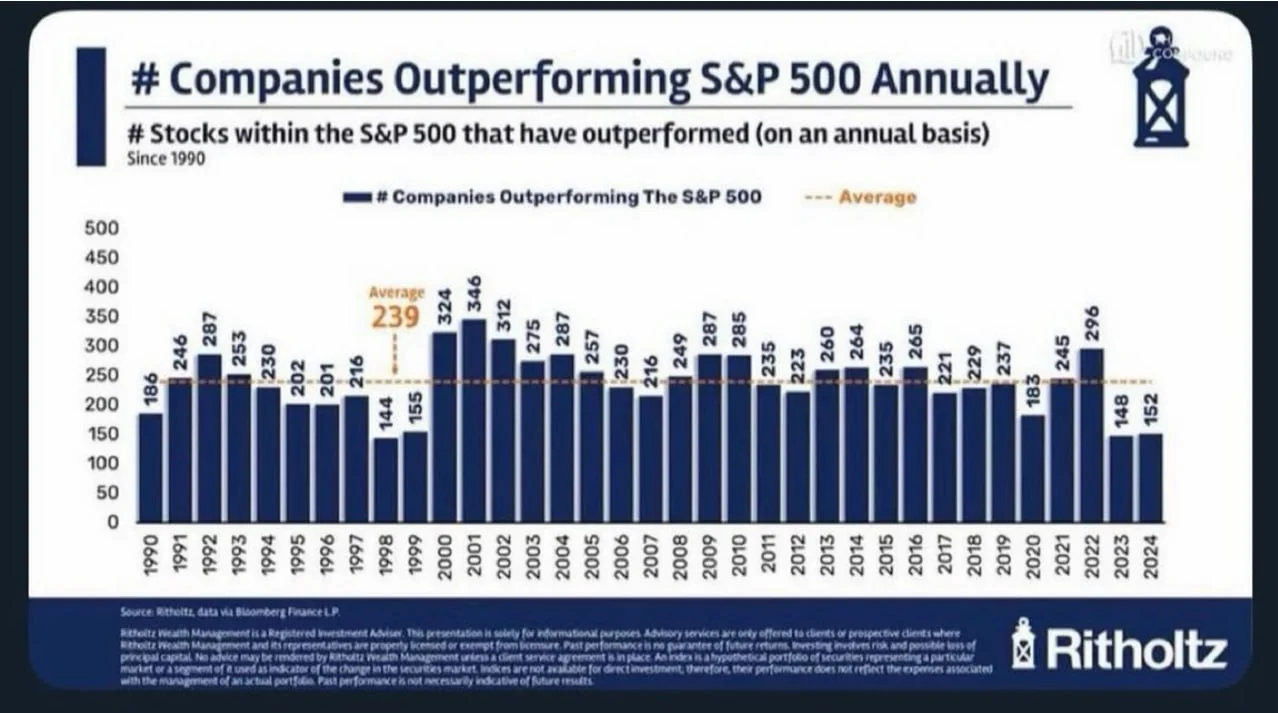
The chart below shows how many companies within the S&P 500 outperform the index itself on an annual basis, starting from 1990. The long-term average is roughly 239 out of 500 companies — less than half.
Less Than 50% Beat the Benchmark
In a typical year, more than half of the stocks inside the index actually deliver returns worse than the index itself. That may seem counterintuitive at first. But the S&P 500 is weighted by market capitalisation — meaning larger companies have a greater influence on overall performance.
When a small group of mega-cap stocks rallies strongly, it can lift the entire index even if the majority of components lag behind.
Wide vs. Narrow Markets
There have been periods of broad participation. During the late 1990s and again in 2021–2022, more than 280–320 companies outperformed the benchmark. Those were years of widespread upside momentum.
But there have also been extremely narrow markets. In 1998, 1999, 2023 and 2024, only around 140–155 companies managed to beat the index. That implies that gains were heavily concentrated in a limited group of leaders.
Such concentration increases the difficulty of stock selection. The probability of consistently choosing the relatively small subset of outperformers falls well below 50%.
The Structural Advantage of Passive Investing
This dynamic explains why passive strategies tracking broad indices often outperform the majority of active managers over long horizons. The index automatically owns the companies driving performance — no forecasting required.
Markets rarely rise evenly. More often, they advance because a handful of dominant firms pull the benchmark higher.
In short: the index is not an “average stock.” It is a weighted structure that rewards scale and leadership. For individual stock pickers, statistics are not always in their favour.
-
 Trying to “Buy the Dip”? These S&P 500 Numbers Tell a Different StoryInvesting Strategies
 -
Why Emotions Are the Fastest Way to Lose Money in MarketsInvesting Strategies
-
This One Investing Lesson Can Change Long-Term ReturnsInvesting Strategies
-
SGOV ETF Explained: How Ultra-Short U.S. Treasuries Work as a Cash AlternativeInvesting Strategies
-
5 Signs You’re Not Really Investing — Just Easing Your ConscienceInvesting Strategies
-
Why Some High Earners Struggle in RetirementInvesting Strategies