S&P 500 Faces Risk as High-Low Logic Index Enters Extreme Zone
The NYSE High-Low Logic Index has surged above 1.82, a historically rare level often followed by S&P 500 weakness. Here’s what past signals show and why this time may be different.
 Daniel Brooks
U.S. equities are showing an unusual internal split. While a growing number of stocks are pushing to fresh highs, an equally notable share is hitting new lows — a divergence that historically has signaled instability beneath the surface of the broader market.
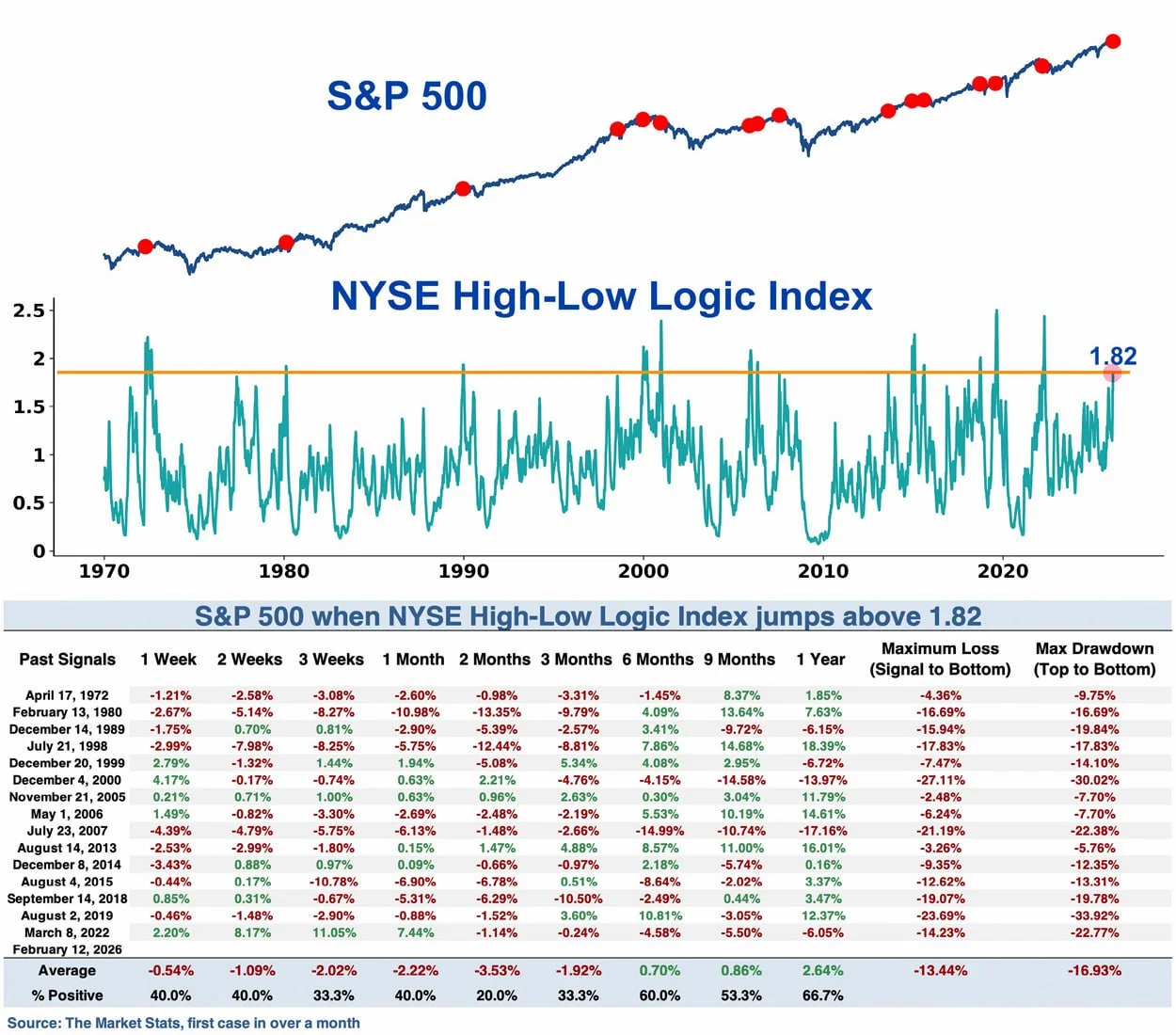
The NYSE High-Low Logic Index has now jumped above 1.82, entering what market historians consider an extreme zone. The indicator measures the simultaneous expansion of new highs and new lows — something that rarely occurs during stable bull markets.
What History Shows
When the index previously moved above 1.82, forward returns for the S&P 500 were notably weak in the near term. Two months after similar signals, the benchmark index declined in roughly 80% of historical cases.
The average maximum drawdown following those signals approached 17%, highlighting how sharp internal market divergence can precede meaningful corrections.
Why This Signal Matters
The High-Low Logic Index reflects breadth stress. In healthy bull markets, new highs expand while new lows contract. When both rise together, it often indicates sector rotation turbulence, liquidity concentration, or late-cycle behavior.
In short: participation narrows, volatility rises, and leadership becomes unstable.
Is This Time Different?
Some strategists argue that structural factors may dampen the predictive power of older breadth indicators. With President Trump placing visible emphasis on equity market performance — particularly ahead of midterm elections — policy decisions could skew toward maintaining financial stability.
A sharp equity selloff heading into an election cycle would represent a political liability. As a result, fiscal and rhetorical support for markets may remain strong.
Still, history suggests that extreme internal divergence rarely resolves quietly. The coming weeks will determine whether this signal marks the start of a broader pullback — or simply another false alarm in a liquidity-driven market cycle.
-
 Overbought Signal Appears Across US Stocks After Strong RallyStocks
 -
Stock Market Leadership Rotates Away From Mega-Cap TechStocks
-
BofA Survey Signals Extreme Optimism as Cash Levels Hit Record LowsStocks
-
S&P 500 and Nasdaq Futures Consolidate Near Record Highs as Volatility Stays SubduedStocks
-
Strong Momentum in Chinese Stocks Meets Growing Policy ConstraintsStocks
-
US Stock Futures Consolidate as Investors Await Jobless ClaimsStocks