How Much Do Stocks Usually Fall During Oil Crises?
Oil prices have surged far beyond historical geopolitical shock averages following the latest strikes on Iran, while equity markets have reacted far less dramatically than in past crises, Deutsche Bank analysis shows.
 Daniel Brooks
Oil prices have surged far more sharply than usual during the latest geopolitical escalation involving Iran, while equity markets have shown a comparatively muted reaction.
According to a historical analysis compiled by Deutsche Bank, geopolitical shocks tied to oil supply disruptions have typically triggered strong moves in crude prices and moderate drawdowns in equities.
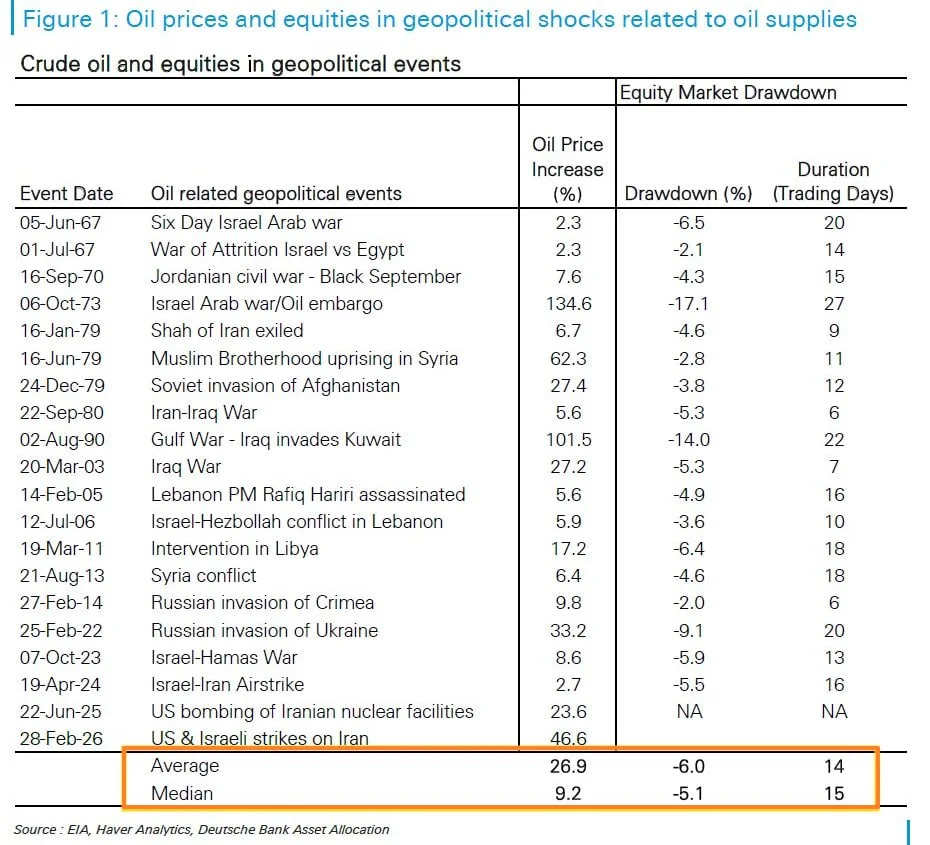
Across multiple crises since the late 1960s, oil prices have risen about 27% on average, while the S&P 500 historically declined around 6% during the same episodes.
However, the current market reaction appears to be deviating from those historical patterns.
Oil Moving More Than History Suggests
Following the latest escalation involving U.S. and Israeli strikes on Iran, oil prices have already surged roughly 47% from pre-shock levels.
That move is significantly larger than the historical average response observed during past geopolitical supply shocks.
By contrast, the reaction in equity markets has so far remained relatively contained. The S&P 500 has declined only about 5%, roughly in line with the historical average drawdown despite the much stronger move in crude.
This divergence suggests that investors may be treating the latest geopolitical shock differently from prior oil-driven crises.
What History Shows
Deutsche Bank’s historical comparison includes events such as the 1973 oil embargo, the Gulf War, the Iran-Iraq War, Russia’s invasion of Ukraine, and the recent Middle East conflicts.
The data shows a consistent pattern: oil prices typically spike sharply during supply disruptions, while equities tend to experience short but noticeable drawdowns lasting roughly two to three weeks.
Why Equities May Be Holding Up
There are several possible explanations for the relatively mild equity response so far.
- Expectation of limited supply disruption. Traders may believe the conflict will not significantly damage global oil flows.
- Stronger macro backdrop. Corporate earnings and economic data have remained relatively resilient.
- Market positioning. Investors have become more accustomed to geopolitical risk events in recent years.
In other words, oil markets appear to be pricing in a more severe disruption than equity markets are currently willing to assume.
The Key Question for Investors
Historically, the equity selloff following geopolitical shocks tends to occur quickly but also stabilizes within a few weeks.
If oil prices remain elevated or continue rising, equity markets could still react more strongly in the coming sessions. For now, however, the current episode stands out as an unusual case where oil has surged far beyond historical norms while stocks have barely moved.
Oil prices historically rise about 27% during geopolitical supply shocks while equities fall around 6%. In the current episode, oil has already surged 47% while the S&P 500 has declined only 5%.
-
 S&P 500 Holds Near Key Levels as Markets Weigh Middle East Risks and U.S. DataStocks
 -
S&P 500 Futures Slide as Middle East Escalation Fuels VolatilityStocks
-
Oil Near $100 and Trade Tensions Pressure U.S. Stock FuturesStocks
-
BofA Survey Signals Extreme Optimism as Cash Levels Hit Record LowsStocks
-
Strong Momentum in Chinese Stocks Meets Growing Policy ConstraintsStocks
-
S&P 500 and Nasdaq Futures Consolidate Near Record Highs as Volatility Stays SubduedStocks