Microsoft Faces a Water Paradox as AI Boom Pushes Consumption Toward 2030 Highs
Microsoft projects a sharp rise in water consumption by 2030 as AI-driven data center expansion collides with the company’s long-term sustainability goals.
 Sophia Bennett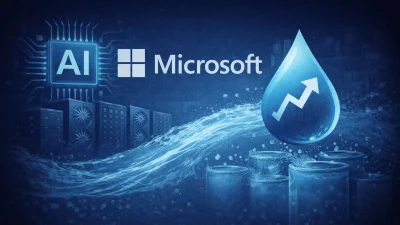
Microsoft is confronting a growing contradiction in its environmental strategy. Just a few years after outlining ambitious plans to become “water positive,” the rapid expansion of artificial intelligence infrastructure is forcing the company to revise its long-term resource outlook.
The acceleration of AI workloads — particularly the training and operation of large-scale models — is sharply increasing cooling requirements across Microsoft’s global network of data centers.
Numbers That Redefine the Outlook
Internal projections point to a steep trajectory. Microsoft operates more than 400 data centers worldwide and expects water usage at its 100 largest facilities to increase dramatically by the end of the decade.
- 2020: 7.9 billion litres of water consumed
- 2024: 10.4 billion litres
- 2030 (internal estimate): up to 28 billion litres
The company’s updated public guidance is more conservative, projecting annual consumption of around 18 billion litres by 2030 — roughly 150% above 2020 levels. Even under this scenario, the trend remains decisively upward.
What the Forecasts Leave Out
A key concern is that Microsoft’s revised projections do not fully account for recently announced data-center construction commitments, including contracts valued at approximately $50 billion.
As new AI-focused facilities come online, actual water usage could exceed even the updated forecasts, particularly if demand for compute capacity continues to accelerate.
Regional Pressure Points
The issue is most acute in regions already facing water stress.
Cities such as Jakarta and Phoenix are experiencing chronic water shortages. The expansion of water-intensive data centers in these areas risks intensifying local supply constraints and increasing regulatory and community scrutiny.
For hyperscale operators, location is becoming as critical as compute power.
An Industry-Wide Challenge
Microsoft’s situation reflects a broader structural issue across the technology sector. As AI adoption scales, water consumption is rising in parallel.
Most large data centers still rely on water-based cooling systems to maintain stable operating conditions. While alternative cooling technologies are being explored, no solution has yet proven capable of replacing water use at hyperscale.
Innovation vs. Sustainability
The widening gap between AI-driven growth and existing sustainability frameworks is becoming increasingly visible. Environmental targets were largely designed for a pre-AI growth curve.
Unless meaningful breakthroughs in cooling efficiency emerge, the water footprint of the digital economy may become one of its most binding constraints.
For Microsoft — and for the industry as a whole — the next decade will be defined by how effectively that balance is managed.
-
 OpenAI Faces Toughest Rivalry Since 2022AI & Automation
 -
Google and Amazon Target Nvidia’s Weak Spot With Custom AI Inference ChipsAI & Automation
-
Zeta Global Emerges as a Structural Winner in AI-Driven MarketingAI & Automation
-
AI Models Lose Money in Real-Money Stock TradingAI & Automation
-
Mickey, Marvel and Star Wars Are Coming to OpenAI’s SoraAI & Automation
-
NVMe SSDs Now Cost More Than Gold on a Per-Gram BasisAI & Automation