Google and Amazon Target Nvidia’s Weak Spot With Custom AI Inference Chips
Alphabet and Amazon are accelerating development of custom AI chips, aiming to reduce dependence on Nvidia by dominating the fast-growing inference market.
 Sophia Bennett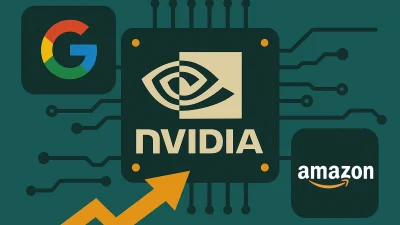
From an editorial perspective, the significance lies in how rapidly the AI ecosystem is shifting away from general-purpose GPUs and toward vertically integrated stacks. Alphabet and Amazon are now leading this structural pivot, redefining the economics of AI deployment.
Big Tech Pushes Into Custom Silicon
Alphabet and Amazon are no longer just customers of the AI hardware industry — they are becoming full-stack AI infrastructure providers. Both companies are designing proprietary chips and deploying them inside tightly integrated platforms that reduce costs, improve inference performance, and limit reliance on Nvidia’s GPU roadmap.
Alphabet’s strategy centers around its long-running TPU program. The newest generation — TPU v7 “Ironwood” — is engineered for high-throughput, low-latency inference and scaled serving of large models. Think of it as a purpose-built engine for the workloads that now dominate the commercial AI landscape.
Inference Becomes the Battlefield
Inference — the process of running trained AI models — is quickly outgrowing AI training in economic value. Unlike training, which requires state-of-the-art GPUs, inference rewards efficiency, specialization, and low operational cost.
That is precisely where Alphabet and Amazon see their opportunity.
Amazon’s chips, Trainium and Inferentia, anchor a similar full-stack approach. AWS Inf2 instances deliver up to 3× higher compute and 10× lower latency versus their earlier generation, dramatically reducing the cost of deploying AI applications at scale.
The Full-Stack Advantage
Sophia Bennett explains: “Think of this as shifting from renting someone else’s high-end hardware to owning a purpose-built system designed exactly for your workflows.”
By controlling every layer — from the silicon to the AI model APIs — Alphabet and Amazon can tune performance at a level Nvidia simply cannot replicate without owning the entire cloud environment.
This is not a direct attack on Nvidia’s leadership in training. In fact, both Google Cloud and AWS continue to purchase Nvidia’s most advanced GPUs for customers who require CUDA compatibility and maximal performance.
Instead, the competition is arriving from the flanks: specialized inference hardware that eats into Nvidia’s fastest-growing revenue stream.
Economic Pressure: Nvidia’s “Achilles’ Heel”
Nvidia’s biggest long-term risk is not a better GPU — it is the shifting economics of AI computing. A $30,000 GPU is powerful, but it is expensive to run and unnecessary for most inference tasks. As AI spending becomes usage-based, CFOs will begin optimizing for the lowest cost per inference, not the highest possible performance.
This is where Alphabet’s TPUs and Amazon’s Inferentia chips excel. Their long-term payoff comes from massive efficiency gains, especially at hyperscale levels where cost savings compound.
For cloud giants willing to invest tens of millions upfront to design ASICs, the return on investment becomes clear over time — and it becomes difficult for Nvidia to compete with that economic structure.
A More Volatile Future for Nvidia
The result is a future where Nvidia’s customer base becomes less concentrated, cloud providers reduce reliance on general-purpose GPUs, and AI inference shifts decisively toward custom accelerators optimized for cost efficiency.
In the long run, that makes Nvidia’s revenue less predictable — and its margins more exposed.
Alphabet and Amazon aren’t trying to outgun Nvidia in raw performance. Instead, they are building vertically integrated AI stacks that make Nvidia’s GPUs unnecessary for the majority of inference workloads. The battle for the economics of AI has begun — and it’s happening below the training layer.
-
 OpenAI Faces Toughest Rivalry Since 2022AI & Automation
 -
Zeta Global Emerges as a Structural Winner in AI-Driven MarketingAI & Automation
-
Mickey, Marvel and Star Wars Are Coming to OpenAI’s SoraAI & Automation
-
Market Misread? The Real Reason CoreWeave Shares DroppedAI & Automation
-
AI Models Lose Money in Real-Money Stock TradingAI & Automation
-
Nvidia Regains China Access After Months of “Zero Sales” ForecastsAI & Automation