OpenAI Faces Toughest Rivalry Since 2022
OpenAI has issued a “code red” internal alert as Google’s Gemini accelerates, sparking concerns about lost leadership, stalled training cycles and rising legal constraints. Is this a crisis—or the natural end of OpenAI’s monopoly?
 Sophia Bennett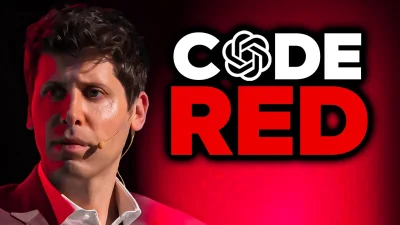
From an editorial perspective, the significance lies in how quickly the centre of gravity in the AI ecosystem can shift. OpenAI, once the undisisputed engine of innovation behind the modern LLM boom, is now confronting its most serious competitive pressure since the launch of ChatGPT.
According to internal communications reported across the industry, CEO Sam Altman has issued a “code red” memo urging the team to urgently reallocate talent, compute and resources toward one mission: restoring ChatGPT’s dominance. The message is clear — Google’s Gemini surge is no longer a distant threat but an immediate strategic challenge.
Google vs. OpenAI: a three-year reversal
In December 2022, Google was the first Big Tech player to declare an internal “code red” after ChatGPT ignited an AI revolution. Three years later, roles have reversed. Google’s new Gemini models, deeply integrated across Search, Android and Workspace, are rapidly capturing usage share — something OpenAI’s leadership now openly acknowledges.
Altman’s memo reportedly states: “We are in a critical moment for ChatGPT; we must swiftly redirect people, compute and focus to regain leadership in AI chatbots.” Several side projects are said to be paused as a result.
A community backlash — and technical concerns
The AI community is increasingly vocal about OpenAI’s slower progress since the departure of co-founder Ilya Sutskever in 2024 — a moment many researchers describe as a strategic turning point. Analysts at SemiAnalysis highlight several structural issues:
- No major completed pre-training cycles for frontier models since mid-2024.
- Lack of expansion in Nvidia GPU clusters throughout 2024–2025.
- Convergence challenges in experimental architectures.
- GPT-5 reportedly relying heavily on post-training atop legacy GPT-4o infrastructure.
The contrast with Google is sharp: the company benefits from one of the world's largest proprietary data ecosystems and internal training pipelines spanning Search, YouTube, Maps, mobile devices and cloud infrastructure.
Legal pressure and censorship constraints add friction
OpenAI is now the most legally scrutinized AI lab in the world. Lawsuits concerning training data, copyright and content moderation force the company into stricter guardrails, raising costs and slowing experimentation. By contrast, competitors adopt more aggressive strategies:
- xAI continues to scrape and train at scale with minimal limitations.
- Google leverages massive in-house datasets protected by long-standing licenses.
- Anthropic focuses sharply on corporate clients — now over 85% of its revenue — avoiding the mass-market risks OpenAI faces.
Another point of tension is censorship. Developers and power-users frequently complain that ChatGPT responses have become overly neutral and politically filtered — which positions models like xAI’s Grok, with minimal guardrails, as a tempting alternative.
The cost of being “too big to fall”
As companies scale, innovation naturally becomes less aggressive and more risk-managed. OpenAI now carries responsibilities to partners, enterprise clients, and major investors — including one of the largest strategic shareholders in the tech industry. With such a structure, even small missteps can become costly.
And for OpenAI, leadership is not optional. It is the foundation of its valuation, its funding pipeline and its brand. Unlike Google — a diversified giant with advertising, cloud, hardware and enterprise businesses — OpenAI relies heavily on subscriptions and API usage. Losing leadership risks triggering customer migration, revenue erosion and investor pressure.
Competition or crisis?
At the heart of it, the situation reflects a broader truth: more competition drives more innovation. The AI sector is entering a phase where no single company can maintain monopoly power. Google is accelerating, Anthropic is capturing the enterprise segment, xAI is pushing the boundaries of permissiveness, and open-source ecosystems continue to evolve at staggering speed.
OpenAI, once the unchallenged pioneer, is now—perhaps for the first time—forced to defend its position rather than define the next frontier.
-
 Google and Amazon Target Nvidia’s Weak Spot With Custom AI Inference ChipsAI & Automation
 -
Nvidia Regains China Access After Months of “Zero Sales” ForecastsAI & Automation
-
Mickey, Marvel and Star Wars Are Coming to OpenAI’s SoraAI & Automation
-
AI Models Lose Money in Real-Money Stock TradingAI & Automation
-
OpenAI Says AI Is Saving Workers Up to an Hour a DayAI & Automation
-
Market Misread? The Real Reason CoreWeave Shares DroppedAI & Automation