Breakthrough 1nm Transistor From China Could Cut AI Chip Power Use
Researchers from Peking University and the Chinese Academy of Sciences report a breakthrough 1nm ferroelectric transistor that could dramatically reduce power consumption in future AI chips.
 Sophia Bennett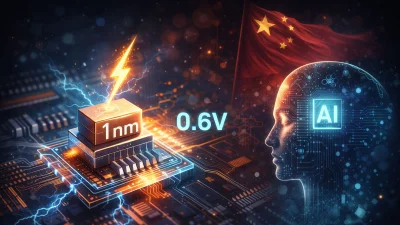
Chinese researchers have reported a major semiconductor breakthrough that could significantly reduce the power consumption of future AI chips.
A joint team from Peking University and the Chinese Academy of Sciences has developed a new type of ferroelectric transistor with a gate length of just 1 nanometer and an ultra-low operating voltage of 0.6 volts.
The research was published in Science Advances in February 2026 under the paper titled “Nanogate ferroelectric transistors with ultralow operation voltage of 0.6 V.”
Why this transistor matters for AI hardware
The significance of the discovery is not only the extreme miniaturization, but also the potential solution to one of the biggest hidden problems in modern AI chips — the mismatch between memory and compute architectures.
Modern logic processors typically operate at very low voltages, often around 0.7V, to maximize energy efficiency.
However, mainstream non-volatile memory technologies such as NAND flash still require significantly higher voltages — often 5V or more — to write data.
This voltage gap forces chip designers to include additional power-conversion circuits. Those circuits consume energy, occupy chip area and introduce latency during data transfers.
In large-scale AI workloads, where data constantly moves between memory and compute units, this inefficiency becomes a major bottleneck.
The hidden energy cost of moving data
Industry analyses suggest that in many modern AI accelerators, as much as 60% to 90% of total energy consumption is spent not on computation itself, but on moving data between memory and processing units.
This is why many semiconductor companies are focusing on architectures that bring memory and compute closer together — often referred to as compute-in-memory or near-memory computing.
The newly demonstrated transistor could help bridge that gap by enabling memory elements that operate at much lower voltages, closer to those used by logic circuits.
What is a ferroelectric transistor
A ferroelectric transistor (FeFET) uses special materials with ferroelectric properties that allow electrical states to be stored even when power is turned off.
This makes the device capable of acting as a non-volatile memory element, meaning it can retain information without continuous power.
FeFET technology has long been considered promising because it offers:
- fast switching speeds
- low power consumption
- non-volatile data storage
- compatibility with advanced semiconductor processes
The main obstacle historically has been scaling the technology down while maintaining low operating voltage.
The Chinese research team claims the new 1nm nanogate design addresses this limitation, allowing the transistor to operate at just 0.6V, which is much closer to the voltage range used by modern logic chips.
Potential implications for future AI chips
If the technology proves scalable for manufacturing, it could help create AI processors that:
- consume significantly less energy
- reduce latency in memory-compute communication
- require fewer voltage-conversion circuits
- enable new compute-in-memory architectures
In practical terms, this could translate into more efficient data centers, longer battery life for AI devices and improved performance for machine learning workloads.
While commercial adoption remains uncertain, the research highlights how semiconductor innovation is increasingly focused not just on smaller transistors, but on solving the architectural bottlenecks that limit AI hardware performance.
-
 Google and Amazon Target Nvidia’s Weak Spot With Custom AI Inference ChipsAI & Automation
 -
NVMe SSDs Now Cost More Than Gold on a Per-Gram BasisAI & Automation
-
Nvidia Regains China Access After Months of “Zero Sales” ForecastsAI & Automation
-
OpenAI Faces Toughest Rivalry Since 2022AI & Automation
-
Zeta Global Emerges as a Structural Winner in AI-Driven MarketingAI & Automation
-
OpenAI Says AI Is Saving Workers Up to an Hour a DayAI & Automation