OpenAI Says AI Is Saving Workers Up to an Hour a Day
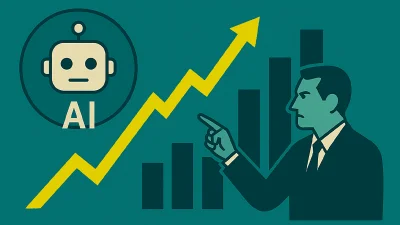
OpenAI’s new survey suggests AI tools save workers 40–60 minutes a day, with 75% reporting improved speed or quality. Enterprise adoption is accelerating.
 Sophia Bennett
From an editorial perspective, the significance lies in how quickly AI is embedding itself into day-to-day workflows. OpenAI’s new internal survey suggests that artificial intelligence tools are delivering measurable productivity gains, even as academic research continues to question AI’s real economic impact.
According to the company’s study of 9,000 workers across 100 firms, employees reported saving 40 to 60 minutes a day on professional tasks by using ChatGPT and other OpenAI products. The strongest gains came from roles in data science, engineering, communications and accounting.
Roughly three-quarters of surveyed employees said AI improved the speed or quality of their output — a finding OpenAI is now highlighting amid persistent skepticism over whether AI is delivering meaningful returns for businesses.
Academic research remains unconvinced
Just months ago, MIT researchers reported that most organizations saw zero return on their generative AI investments. Harvard and Stanford researchers separately argued that professionals were increasingly producing “workslop,” a term describing AI-generated content that looks polished but fails to meaningfully advance work.
Those findings helped fuel concerns about a budding AI bubble — one driven more by corporate spending than proven value.
OpenAI pushes back with new adoption data
OpenAI executives argue that what they observe inside enterprises tells a different story. “There’s a lot of studies flying around … they never quite line up with what we see in practice,” said Brad Lightcap, the company’s Chief Operating Officer.
The report states that enterprise adoption is accelerating and, in some cases, growing faster than consumer usage. OpenAI now counts over 1 million businesses as paying customers and reports 7 million paid workplace seats for ChatGPT.
Employees were surveyed three to four weeks after adopting the tools. Workers who used the most advanced AI models and integrated multiple tools saw the largest benefits.
New types of work — and new behaviours
OpenAI also found signs that AI is enabling workers to perform tasks outside their formal roles. Employees in engineering, IT and research — but not in technical positions — increased their coding-related messages by 36% in just six months.
“Three out of four people are now saying, ‘I can do things I couldn’t do before,’” said Ronnie Chatterji, OpenAI’s Chief Economist. He added that this shift is often overlooked in discussions about AI’s impact on labour.
While debates over the true economic value of AI will continue, OpenAI’s latest findings highlight a growing divide: academic skepticism on one side, and rapidly rising enterprise adoption on the other.
-
 OpenAI Faces Toughest Rivalry Since 2022AI & Automation
 -
Most New Articles Are Written by AI — Not PeopleAI & Automation
-
Mickey, Marvel and Star Wars Are Coming to OpenAI’s SoraAI & Automation
-
Zeta Global Emerges as a Structural Winner in AI-Driven MarketingAI & Automation
-
Google and Amazon Target Nvidia’s Weak Spot With Custom AI Inference ChipsAI & Automation
-
AI Hype vs. Reality: Tech Experts Challenge Wall Street’s Bullish NarrativeAI & Automation