Most New Articles Are Written by AI — Not People
A new Graphite study shows AI-generated articles now exceed human-written content online, though growth has plateaued as performance in search remains limited.
 Sophia Bennett
A new large-scale analysis from Graphite shows that AI-generated articles now make up the majority of newly published content on the web — a milestone reached in late 2024. The findings highlight how quickly generative AI tools reshaped digital publishing after the launch of ChatGPT in November 2022.
The research, based on a sample of 65,000 English-language articles from CommonCrawl, reveals that AI-written content grew from near-zero levels in early 2020 to more than half of all articles by November 2024. The rise closely tracks the timeline of widespread adoption of LLMs, content automation platforms, and AI-assisted editorial workflows.
The Shift Toward AI Publishing
Graphite’s dataset shows a dramatic acceleration beginning in early 2023. Within twelve months of ChatGPT’s release, AI-generated articles reached 39% of all new online publications. By late 2024, the share exceeded 50%, marking the first time automated systems produced more content than humans.
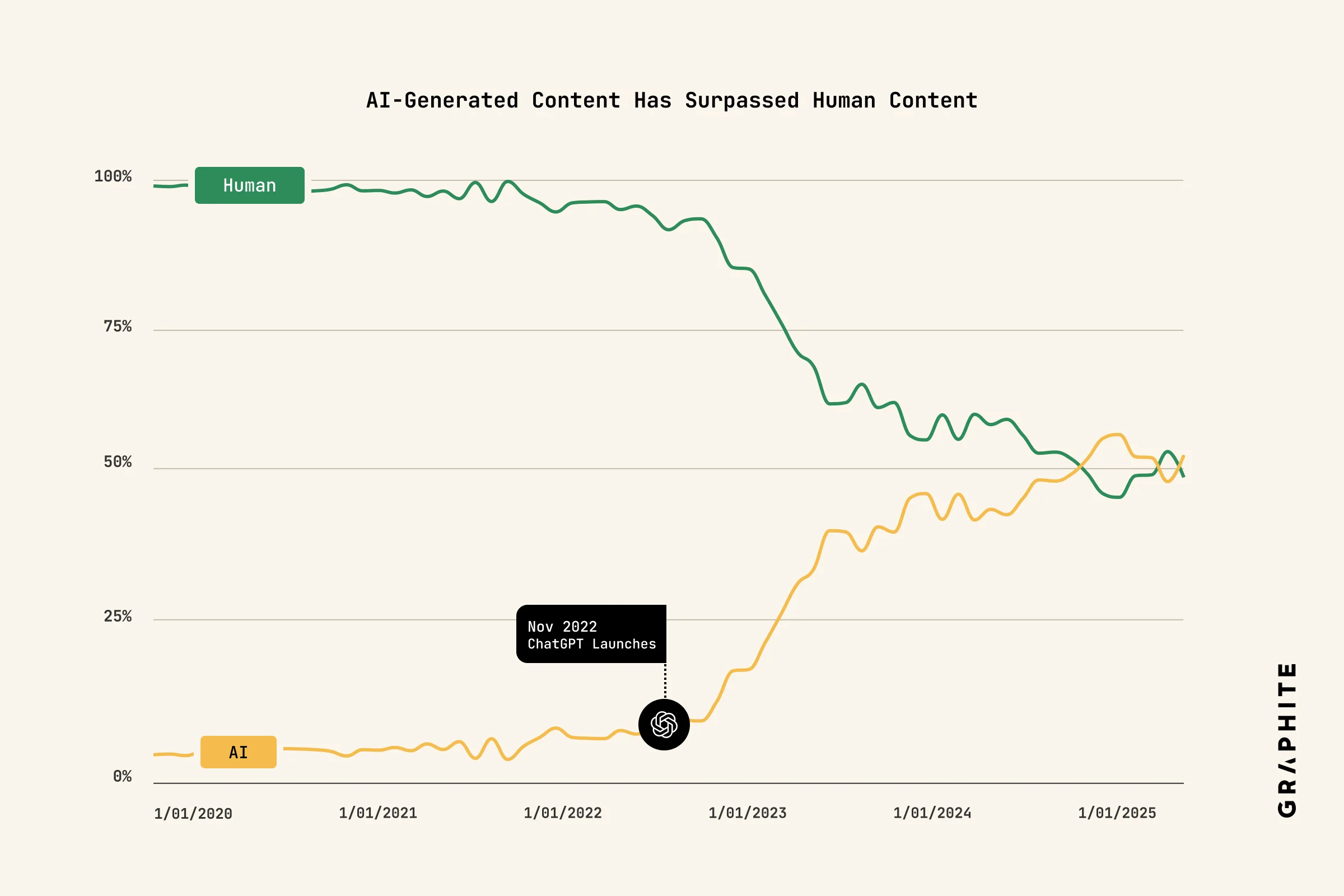
However, despite early exponential growth, the proportion of AI-produced content has plateaued since mid-2024. The study suggests that many publishers discovered a key limitation: AI articles often fail to perform in search engines and do not appear prominently in Google Search or ChatGPT results.
Accuracy and Detection
To classify content, Graphite used SurferSEO’s AI detection model with 500-word chunks. Prior to analysis, the team validated the tool’s accuracy:
- False positive rate: 4.2% when scanning human-written articles published before ChatGPT (2020–2022)
- False negative rate: 0.6% when scanning 6,009 GPT-4o-generated articles
“Detection isn’t perfect, but the model performs reliably enough to map high-level trends in AI adoption.”
With detection calibrated, Graphite classified the full 65k-article dataset, determining that the majority of new online content is now AI-generated or AI-assisted.
The report notes that AI article growth has remained flat for the past year. A likely reason is performance: although AI has dramatically lowered production costs, many automated articles underperform in search rankings. Publishers appear to be pulling back or shifting to hybrid human-edited workflows.
What This Means for the Web
The findings reinforce two major industry dynamics:
- AI is now the dominant source of new written content.
- Search visibility remains the key bottleneck, limiting the real-world impact of AI-generated posts.
In practical terms, the internet may host more AI-written pages than ever, but users may not see them. Many remain buried deep in search results — or excluded entirely.
As AI content continues to evolve, the next competitive advantage for publishers may be balancing scale with editorial quality, trust, and human-driven refinement.
-
 OpenAI Faces Toughest Rivalry Since 2022AI & Automation
 -
AI Models Lose Money in Real-Money Stock TradingAI & Automation
-
Mickey, Marvel and Star Wars Are Coming to OpenAI’s SoraAI & Automation
-
Google and Amazon Target Nvidia’s Weak Spot With Custom AI Inference ChipsAI & Automation
-
OpenAI Says AI Is Saving Workers Up to an Hour a DayAI & Automation
-
Zeta Global Emerges as a Structural Winner in AI-Driven MarketingAI & Automation