Why Floating-Rate Bonds Still Pay More — Despite Strong Demand
Floating-rate corporate bonds continue to offer higher yields than fixed-rate issues from the same issuers. Here’s why this apparent market paradox makes sense.
 Olivia Carter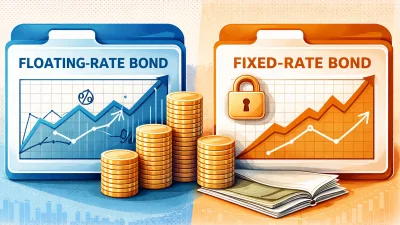
Corporate bond markets are sending a mixed signal. Floating-rate bonds remain in high demand — yet they still offer higher potential yields than fixed-rate bonds issued by the same companies. Same credit risk. Different returns. Counterintuitive? Not really.
This pricing gap reflects how investors are thinking about risk, not a market inefficiency.
What’s Really Driving Demand for Floaters
The key point is simple: investors are not buying floating-rate bonds to maximise yield. They are buying protection.
With interest rates expected to stay elevated for longer — and uncertainty around the timing of future cuts — floating coupons are perceived as insurance against duration risk. That defensive motivation matters more than squeezing out every basis point of return.
As a result, demand stays strong, but prices do not fully adjust to eliminate the yield premium.
Fixed-Rate Bonds Are Priced for a Rate-Cut Story
Fixed-rate bonds tell a different story.
Markets have aggressively priced in future policy easing. Investors are willing to accept lower current yields in exchange for potential price appreciation once rates fall.
In some cases, fixed-rate issues now trade at yields that barely compensate investors for interest-rate risk. The trade is no longer about income — it’s about timing the pivot.
Structural Frictions Keep Floater Yields Elevated
Floating-rate bonds are not always as simple as they appear.
Many include features such as:
- Lagged coupon resets
- Complex reference-rate formulas
- Caps on maximum coupon payments
These structural details reduce appeal for certain investors and justify an additional yield premium — even in periods of strong overall demand.
Different Investors, Different Objectives
Holder composition also matters.
Fixed-rate bonds are heavily used by institutional investors and funds managing duration exposure. Floating-rate bonds, by contrast, are often held as tactical positions focused on cash flow and rate protection.
Different objectives create different pricing dynamics — even for the same issuer.
What Investors Should Focus On
When comparing floating-rate and fixed-rate bonds, the most important variables are often overlooked:
- The coupon base and spread — this defines the true income premium
- Reset frequency and mechanics — lag can materially reduce benefits
- Coupon caps — critical in volatile rate environments
- Relative yield versus fixed bonds from the same issuer, not the market average
Two Strategies, Two Very Different Bets
Buying fixed-rate bonds today is a bet on getting the timing of rate cuts right.
Buying floating-rate bonds is a bet on steady cash flow — and on avoiding that timing risk altogether.
With identical credit risk, the market is still paying a premium for the second approach.
The real question is not which instrument is more popular.
The question is where the market is willing to overpay — and where it is still underpricing risk.
-
 Why China Is “Selling” U.S. Treasuries While the U.K. Is “Buying” ThemBonds & Rates
 -
Something Strange Is Happening to How Investors View Oracle’s FutureBonds & Rates
-
Danish Pension Fund Signals Exit From U.S. Treasuries as Debt Concerns MountBonds & Rates
-
U.S. Mortgage Applications Hit Two-Year High as Buyers Return to the MarketBonds & Rates