Copper Enters a New Cycle After Two Decades of Consolidation
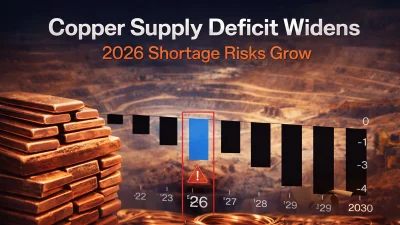
Copper has broken out after nearly two decades of consolidation, with energy transition, AI-driven demand, and slow supply growth pointing to a structural deficit ahead.
 Daniel Brooks
Copper prices have broken above a major technical resistance after nearly 19 years of consolidation. The move marks a breakout from a large ascending triangle formation that had capped prices for almost two decades.
Market participants increasingly view this signal not merely as a technical pattern, but as an early indication of a structural copper deficit that could intensify over the coming years.
Why a copper deficit is becoming more likely
The global energy transition is driving unprecedented demand for copper. An electric vehicle contains roughly four times more copper than a traditional internal combustion engine vehicle. A single wind turbine can require between four and five tonnes of copper, while a 1 GW solar power facility may use close to 5,000 tonnes.
According to estimates from S&P Global, achieving global carbon neutrality by 2050 would require approximately 600% more copper than was mined worldwide over the past five years combined.
Artificial intelligence adds a new layer of demand
The rapid expansion of artificial intelligence infrastructure is further accelerating copper consumption. The construction of large data centres used for training and operating AI models requires substantial volumes of copper for electrical systems and cooling infrastructure.
A single large data centre can consume between 1,500 and 3,000 tonnes of copper — comparable to the usage of a small city. Major technology companies including Microsoft, Google and Amazon have announced data-centre investment plans totalling hundreds of billions of dollars.
Supply constraints remain significant
On the supply side, production growth continues to lag demand. The average timeline from mineral discovery to commercial copper production is estimated at 15 to 20 years, while major new discoveries have become increasingly rare.
Ore grades are also declining. In the 1990s, copper grades of 1–2% were common. Today, many operating mines process ore with copper content closer to 0.5–0.6%, meaning significantly more material must be mined and processed to produce the same amount of metal.
Geopolitical risks add further pressure
Geopolitical factors are adding to supply uncertainty. Chile and Peru account for roughly 40% of global copper production, and both countries face recurring political instability, environmental constraints, and tensions with local communities.
These issues have led to periodic production disruptions, reinforcing concerns about the resilience of global copper supply chains.
How market participants gain exposure to the theme
Market participants use a range of instruments to gain exposure to copper-related trends. Exchange-traded products and futures contracts provide direct price exposure without physical ownership.
Large-scale copper producers with established, high-quality assets — including companies such as Freeport-McMoRan, Southern Copper, Antofagasta and BHP Group — are often viewed as key beneficiaries of rising prices, given their operating leverage and relatively stable cost structures.
Developers with expansion projects, including First Quantum Minerals, Ivanhoe Mines and Lundin Mining, are also closely watched, as project valuations tend to improve significantly in tighter market conditions.
Recycling and refining companies such as Aurubis and Wieland Group may benefit from the growing importance of secondary copper supply within a circular economy framework.
At the higher-risk end of the spectrum, junior exploration companies offer substantial upside potential if new deposits are successfully developed, particularly in a structurally constrained market.
Some investors also use long-dated options on copper or mining equities to express directional views while limiting downside exposure.
A powerful theme, with elevated volatility
Despite the increasingly compelling structural narrative, copper remains a volatile asset. Commodity markets are cyclical by nature, and sharp price corrections remain possible.
Still, for investors who missed earlier moves in gold and silver, copper is increasingly seen as a market where long-term supply-demand imbalances may not yet be fully reflected in prices.
-
 SLV in Focus as Silver Enters a New Structural PhaseCommodities
 -
Copper Set to Become the Next Strategic CommodityCommodities
-
Copper Supply Shock Deepens as 2026 Deficit Risks GrowCommodities
-
Why Copper Is Outperforming Gold — And What It Means for Metals MarketsCommodities
-
A Massive Technical Breakout Suggests Silver’s Run Might Just Be BeginningCommodities
-
Why Copper Prices Are Surging to Record LevelsCommodities