Copper Supply Shock Deepens as 2026 Deficit Risks Grow
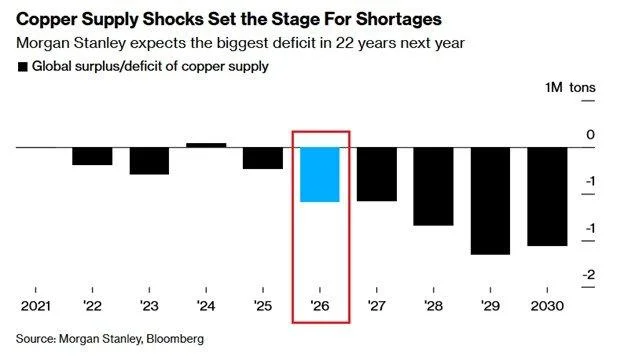
Copper prices are rising as Morgan Stanley warns of the largest supply deficit in 22 years, driven by weak mine output and surging demand from AI data centers and EVs.
 Olivia Carter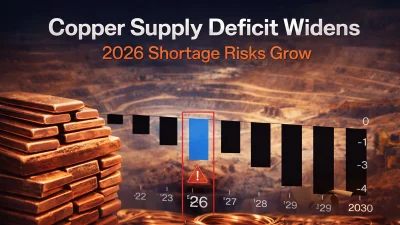
While investor attention has largely centred on silver and other precious metals, copper is quietly emerging as one of the most structurally constrained markets in the commodity complex. Prices are already reflecting this shift.
So far this year, copper prices have surged roughly 43%, marking their strongest annual performance since 2009. Yet forward-looking indicators suggest the rally may be underpinned by more than cyclical momentum.
Largest deficit in more than two decades
According to Morgan Stanley, the global copper market is on track for its most severe supply deficit in 22 years in 2026, with a shortfall estimated at around 590,000 tonnes. The bank’s projections highlight a growing imbalance between structurally constrained supply and rapidly expanding demand.
Production trends reinforce this view. Output in the world’s largest copper-producing country has fallen to some of the weakest levels seen in over a decade, limiting the market’s ability to respond to higher prices.
Demand drivers remain intact
At the same time, demand from AI-driven data centres, grid infrastructure, and electric vehicles continues to accelerate. Copper remains a critical input for power transmission, cooling systems, and charging infrastructure—areas seeing sustained capital expenditure globally.
This demand surge is colliding with long-term supply challenges. Nearly half of the world’s copper mines are over 20 years old, while average ore grades have declined by roughly 40% since 1991. Lower-grade ore has pushed costs higher and slowed the pace of new supply additions.
A structural issue, not a short-term one
Mining companies have struggled for years to keep pace with the industry’s growth requirements. Long permitting timelines, capital intensity, and declining ore quality mean supply responses remain slow—even in a high-price environment.
As a result, market data increasingly suggest that elevated copper prices could persist well beyond the current cycle.
Related coverage
This outlook builds on our earlier analysis of tightening supply conditions in key producing regions. In a previous report, we examined how falling output in Chile is already setting the stage for a broader supply squeeze:
Copper Prices Rise as Chile’s Production Falls, Setting Up a 2026 Supply Squeeze
Taken together, these trends point to copper becoming an increasingly strategic commodity as the global economy transitions toward electrification and AI-intensive infrastructure.
-
 SLV in Focus as Silver Enters a New Structural PhaseCommodities
 -
Central Banks Step Up Strategic Gold Accumulation Amid Macro UncertaintyCommodities
-
Why Copper Is Outperforming Gold — And What It Means for Metals MarketsCommodities
-
A Massive Technical Breakout Suggests Silver’s Run Might Just Be BeginningCommodities
-
Why Copper Prices Are Surging to Record LevelsCommodities
-
Silver Hits Record Levels as Supply From Top Producer Mexico LagsCommodities