Long-Term Bitcoin Holders Turn Net Buyers for First Time Since July
Bitcoin spot ETFs recorded their first net inflows in a week, while on-chain data shows long-term holders turning net buyers for the first time since July.
 Ethan Moore
Bitcoin market dynamics showed early signs of a potential shift as spot ETF flows turned positive and long-term holders stopped distributing coins, according to fresh institutional and on-chain data.
ETF flows turn positive
On December 30, spot Bitcoin ETFs recorded their first net inflow in a week, according to data from SoSoValue. Daily net inflows totaled approximately $355 million, lifting total net assets held by U.S. spot Bitcoin ETFs to around $114.4 billion.
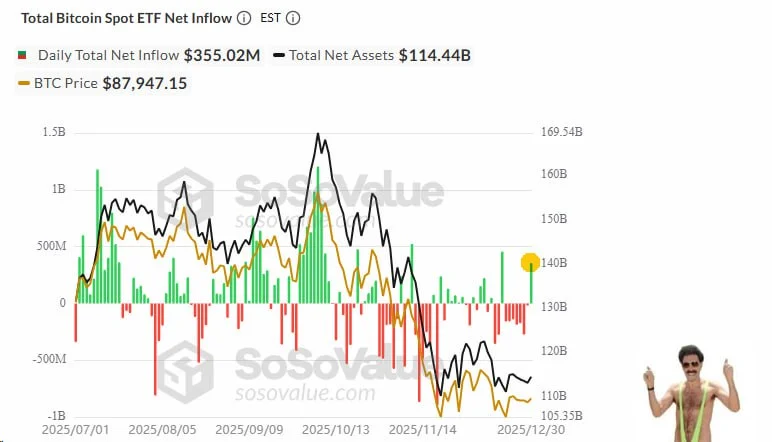
The return of positive flows follows a period of persistent outflows during late December, suggesting a pause in institutional de-risking as Bitcoin prices stabilised near recent highs.
Long-term holders shift to net buying
At the same time, on-chain analytics firm Checkonchain reported a notable development in Bitcoin supply behaviour. For the first time since July, long-term holders (LTHs) have stopped selling Bitcoin and moved back into net accumulation.
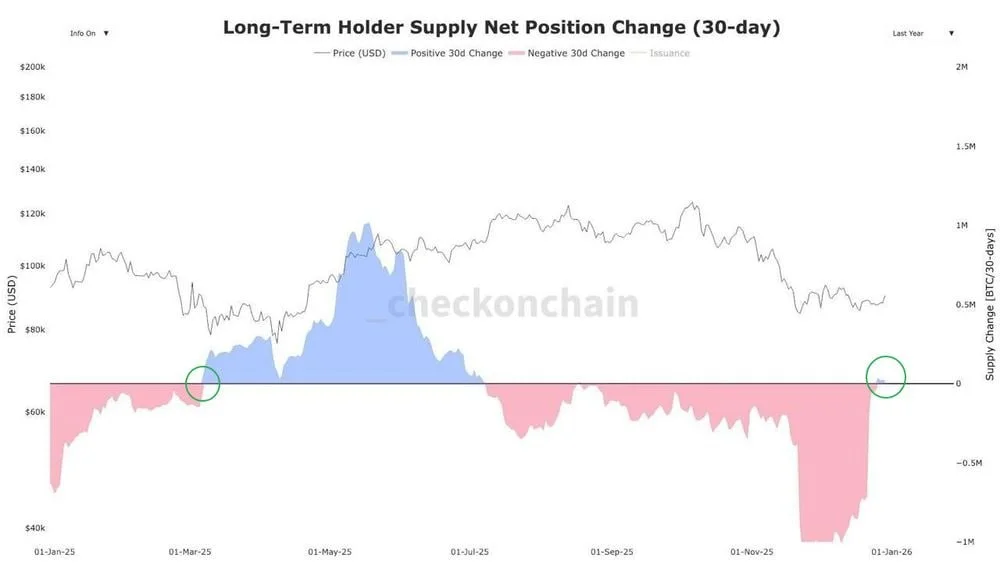
The data shows the 30-day net supply change turning positive, historically a signal that distribution pressure from conviction holders is easing.
Why it matters
The combination of renewed ETF inflows and a shift in long-term holder behaviour points to a potential tightening in Bitcoin’s liquid supply. In previous cycles, similar conditions have often coincided with periods of improved price stability or renewed upside momentum—though not as a guarantee.
With Bitcoin trading near $88,000, market participants are closely watching whether institutional demand and on-chain accumulation can offset near-term macro uncertainty and year-end positioning effects.
For now, both data sets suggest that selling pressure is moderating at current levels, setting the stage for a more balanced supply-demand environment as the market moves into the new year.
-
 Bitcoin Selling Pressure Intensifies Even as Bulls Eye Higher LevelsCrypto & Digital Assets
 -
Crypto ETF Market Pauses After Months of VolatilityCrypto & Digital Assets
-
Brazil’s Largest Private Bank Recommends Holding 1–3% in BitcoinCrypto & Digital Assets
-
Ethereum Finds Support as BitMine Locks Billions in Long-Term StakingCrypto & Digital Assets
-
Bear Market Signals Emerge for Bitcoin, CryptoQuant SaysCrypto & Digital Assets
-
Bitcoin On-Chain Signals Turn Bearish as Market Loses LiquidityCrypto & Digital Assets