S&P 500 and Nasdaq Futures Trade Sideways as PMI and Labor Data Take Center Stage
U.S. equity futures trade sideways near historic highs as investors await key PMI readings and labor market indicators that could define early-2026 market direction.
 Daniel Brooks
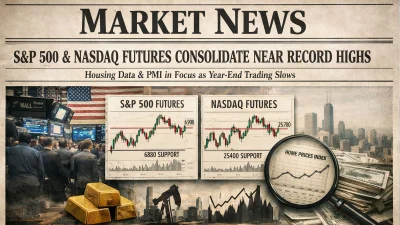
U.S. stock index futures are starting the first full trading week of 2026 in consolidation mode, with both the S&P 500 and Nasdaq holding near record levels. Price action remains cautious as markets position ahead of a dense macroeconomic calendar and a growing set of geopolitical developments.
Previous Session: Mixed Close, Key Levels Respected
In the previous trading session, the S&P 500 finished marginally higher near the 6,850 area, maintaining its consolidation just below recent all-time highs. The Nasdaq, meanwhile, ended slightly lower after testing the lower boundary of its medium-term ascending channel.
The pullback failed to trigger sustained selling pressure, suggesting ongoing dip-buying interest rather than a shift toward risk-off positioning.
Current Price Action: Sideways Near Highs
Today, S&P 500 futures are trading below the 6,900 level, which continues to act as near-term resistance. On the downside, 6,800 remains a key support zone where buyers have repeatedly stepped in.
Nasdaq futures are consolidating around 25,500, holding within their broader upward channel. Immediate support is located near 25,000, a level that has so far limited downside momentum.
From a technical standpoint, the broader trend structure remains constructive, though upside acceleration appears dependent on incoming macroeconomic signals.
What Is Driving the Market This Week
Investor focus this week is firmly on U.S. economic data that could refine expectations for growth, inflation, and monetary policy as the year begins.
- ISM Manufacturing PMI for December, offering insight into activity levels and input costs.
- The ISM Manufacturing Employment Index, closely watched for labor market momentum.
- The ADP employment report for December, providing an early look at private-sector hiring trends.
- Job openings data from the JOLTS survey for November.
- Updated GDPNow estimates for fourth-quarter economic growth.
Once again, investors are recalibrating expectations, weighing signs of economic resilience against the risk of further moderation in activity.
Geopolitics in Focus
Geopolitical developments have moved firmly back into the market narrative, adding an additional layer of uncertainty.
Venezuela. Markets are digesting reports surrounding the detention of Venezuelan president Nicolás Maduro by U.S. forces. The event is unlikely to have a material short-term impact on oil prices, as Venezuela currently accounts for less than 1% of global crude supply.
However, a number of market forecasts point to potential downside risks for oil prices should U.S. sanctions be softened. In such a scenario, accumulated Venezuelan inventories could gradually re-enter the market.
OPEC+. The group has left its plan to pause supply increases unchanged for the first quarter. Against this backdrop, demand for gold has remained elevated, reflecting its role as a defensive asset amid geopolitical uncertainty.
China and global tensions. China has condemned U.S. actions, reviving discussions around a tougher stance from Beijing on Taiwan and the South China Sea. At the same time, Danish Prime Minister Mette Frederiksen has urged Washington to refrain from issuing threats related to Greenland, underscoring rising diplomatic frictions among Western allies.
Sector Performance: Cyclicals Lead
Cyclical sectors led gains in the previous session, with industrials, energy, and defense-related assets showing relative strength. Consumer discretionary stocks underperformed, reflecting selective profit-taking.
Growth sectors posted mostly positive results, led by semiconductors and solar-related equities. Parts of communication services and cloud-exposed names closed lower, highlighting ongoing sector rotation.
Defensive sectors recorded modest gains, with utilities continuing to trade within a well-defined upward channel.
Cross-Asset Signals
- Crude oil is edging lower within a descending channel, with prices gravitating toward the $57 area.
- U.S. Treasury yields remain range-bound near 4.17%, mirroring equity market consolidation.
- Volatility measures are attempting to stabilise after printing recent lows.
- Gold continues to trade within a local ascending channel, holding above the 4,400 level.
Market Outlook
Futures currently point to a moderately positive market open. The overall balance of risks remains neutral, with volatility at manageable levels.
For the near term, the S&P 500 is expected to trade within a 6,820–6,900 range. A sustained move beyond these boundaries will likely require either a clear macro surprise or a further escalation in geopolitical developments.
Until then, consolidation remains the dominant market theme.
-
 US Stock Futures Consolidate as Investors Await Jobless ClaimsStocks
 -
S&P 500 and Nasdaq Futures Consolidate Near Record Highs as Volatility Stays SubduedStocks
-
S&P 500 Futures Stabilize Above 6900 as Year-End Volumes ThinStocks
-
Wall Street Futures Pause Near Highs Ahead of US Housing and PMI DataStocks
-
Markets Open Week on Cautious Optimism Ahead of PCEStocks
-
U.S. Index Futures Pull Back Near Record Highs as Markets Await CPIStocks