VIX Shorts Hit Highest Level Since Mid-2024 — A Warning Sign?
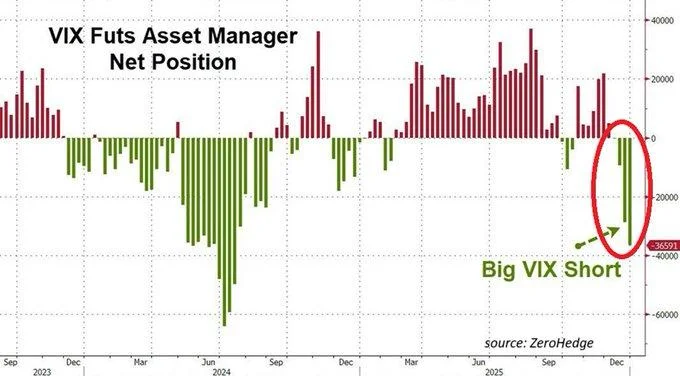
Asset managers have built their largest short positions in VIX futures since July 2024, signaling strong confidence in low volatility — and growing vulnerability to sudden market shocks.
 Daniel Brooks
Asset managers have aggressively increased their short positions in VIX futures, pushing net positioning to the most extreme level since July 2024. In simple terms, funds are making a sizable bet that equity market volatility will remain subdued.
This type of positioning reflects a broader sense of confidence — or complacency — across risk assets. When volatility is heavily shorted, markets tend to assume stable macro conditions, orderly price action, and limited downside surprises.
Why VIX Positioning Matters
The VIX, often referred to as Wall Street’s “fear gauge,” tracks expected volatility in the S&P 500. Large speculative short positions effectively represent a consensus view that near-term market turbulence is unlikely.
However, history shows that such crowded trades can create fragility. When positioning becomes one-sided, even a modest shift in sentiment can force rapid unwinding.
Lessons From 2024
A similar setup emerged in July–August 2024. At the time, asset managers were also heavily short volatility. When risk appetite shifted abruptly, equity markets corrected by nearly 10% in a short period.
The issue is not that low volatility itself is dangerous — but that extreme confidence leaves little margin for error.
What Could Trigger a Reversal
- Unexpected macroeconomic data or inflation surprises
- Shifts in central bank communication or rate expectations
- Geopolitical escalation or policy uncertainty
- Sudden deterioration in market breadth or liquidity
In such conditions, volatility can spike quickly as short positions are covered, amplifying price moves across equities.
Market Takeaway
Extreme short positioning in VIX futures does not predict an immediate sell-off, but it does signal rising vulnerability. When everyone expects calm, markets tend to react more violently to surprises.
For investors, this is a reminder to stay alert, manage risk actively, and avoid assuming that low volatility is a permanent state.
-
 S&P 500 and Nasdaq Futures Consolidate Near Record Highs as Volatility Stays SubduedStocks
 -
Stock Market Leadership Rotates Away From Mega-Cap TechStocks
-
S&P 500 and Nasdaq Futures Trade Sideways as PMI and Labor Data Take Center StageStocks
-
Equity Inflows Reach a Dangerous ExtremeStocks
-
S&P 500 Futures Stabilize Above 6900 as Year-End Volumes ThinStocks
-
Strong Momentum in Chinese Stocks Meets Growing Policy ConstraintsStocks