Global Equity Funds See Biggest Inflows Since 2022 — But Not in the US
Global investors have poured $130 billion into equity funds since the start of 2026, marking the strongest inflows since 2022. However, demand for US equities is cooling rapidly as capital shifts toward international markets.
 Olivia Carter
Global equity markets outside the United States are seeing powerful capital inflows at the start of 2026, while US stock funds are experiencing a sharp slowdown in demand.
According to data from Goldman Sachs and EPFR, eight-week rolling flows into global ex-US equity funds have surged to multi-year highs. At the same time, inflows into US equity funds are moderating quickly.
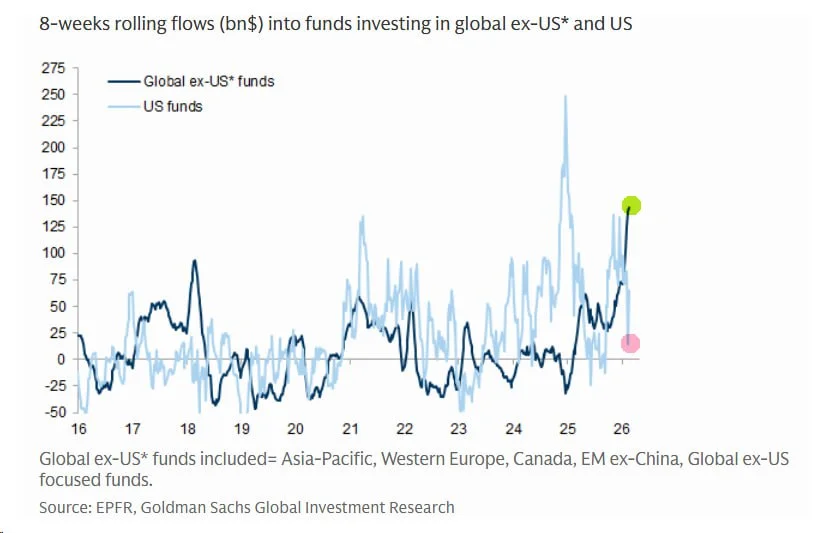
$130 Billion Since January
Bank of America, citing EPFR data, estimates that since the beginning of 2026 global investors have allocated approximately $130 billion into equity funds worldwide — the strongest start to a year since 2022.
However, the composition of those flows has shifted meaningfully.
- Over the past four years, roughly every second dollar entering equity funds went into US-focused strategies.
- In 2026 so far, only one in four dollars is flowing into US equity funds.
The rest is increasingly directed toward Europe, Asia-Pacific, emerging markets (ex-China), and broader global mandates.
Why the Rotation?
Several factors appear to be driving the shift:
- Policy uncertainty surrounding the Trump administration’s trade and fiscal stance.
- Valuation dispersion — US equities remain structurally more expensive than many international markets.
- Currency dynamics and relative growth expectations improving outside the US.
From a positioning perspective, the move is notable. US equities dominated global inflows for nearly four years. That leadership is now being questioned.
While flows into US funds remain positive, the pace has clearly decelerated. The marginal dollar is moving elsewhere.
Is This a Structural Shift?
It is still early to declare a long-term regime change. US markets continue to benefit from deep liquidity, technology sector leadership, and structural earnings power.
However, sustained strength in global ex-US inflows — particularly at record levels relative to recent history — suggests that investors are actively diversifying away from concentrated US exposure.
Flow data often acts as a leading indicator of broader asset allocation trends. For now, the signal is clear: capital is rotating.
-
 Emerging Market Stocks May Be Entering a New Catch-Up PhaseStocks
 -
S&P 500 and Nasdaq Futures Consolidate Near Record Highs as Volatility Stays SubduedStocks
-
US Stock Futures Consolidate as Investors Await Jobless ClaimsStocks
-
News Flow Tilts the Balance Toward BuyersStocks
-
S&P 500 and Nasdaq Futures Trade Sideways as PMI and Labor Data Take Center StageStocks
-
BofA Survey Signals Extreme Optimism as Cash Levels Hit Record LowsStocks