Smart Money Indicator Suggests Market Still in Healthy Uptrend
The Smart Money vs Dumb Money indicator suggests institutional investors remain optimistic while retail sentiment stays moderate, pointing to a stable market environment.
 Daniel Brooks
One of the most closely watched sentiment indicators on Wall Street is currently showing a notable divergence between institutional investors and retail traders.
The Smart Money / Dumb Money Confidence indicator compares the positioning and sentiment of two major groups in the market: institutional investors and retail participants.
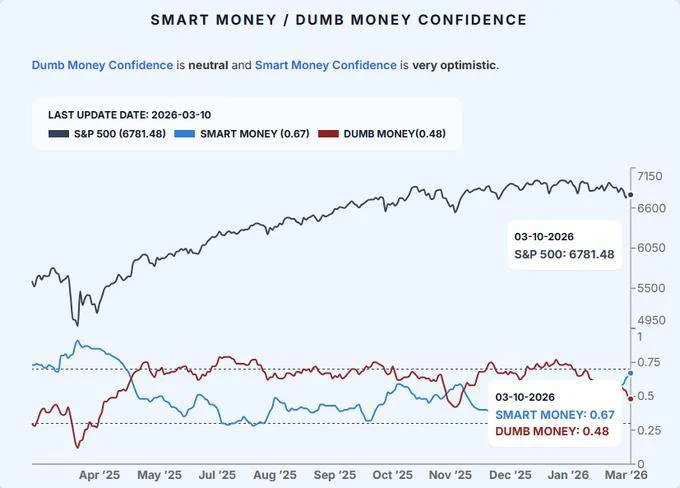
At the moment, the signal suggests that so-called “smart money” remains relatively optimistic, while the confidence of retail investors — often referred to as “dumb money” in market slang — is sitting at a moderate level.
What the Smart Money vs Dumb Money indicator measures
The indicator tracks behavioural differences between two types of market participants:
- Smart Money: institutional investors such as hedge funds, asset managers and large financial institutions that typically operate with deeper research, broader market data and longer investment horizons.
- Dumb Money: retail traders and speculative flows that often react more strongly to headlines, short-term price momentum and social sentiment.
The core logic behind the indicator is relatively straightforward.
When institutional investors remain confident while retail investors are cautious, markets tend to be in a more stable phase of an uptrend. Institutional capital continues to support prices, while the absence of excessive retail optimism reduces the risk of speculative bubbles.
Current signal suggests a healthy market structure
The latest reading shows that Smart Money confidence remains elevated, while Dumb Money sentiment is closer to neutral territory.
In practical terms, this suggests that large market participants are not yet showing signs of aggressively reducing exposure to equities.
At the same time, retail enthusiasm has not reached the extreme levels typically seen near market tops.
This combination often corresponds to a trend continuation phase, where markets continue moving higher but with occasional corrections along the way.
Chart: Smart Money vs Dumb Money Confidence
Why divergences between the two groups matter
Historically, large divergences between institutional and retail sentiment can act as early warning signals.
- If retail investors become extremely optimistic while institutional investors reduce exposure, markets often become vulnerable to corrections.
- If institutions increase positioning while retail sentiment remains weak, the market may still have room to climb.
For now, the indicator suggests a balanced environment.
There are no clear signs of speculative excess, but also no signals of panic or capitulation. In other words, the current sentiment backdrop reflects a market that remains constructive, though not without risks.
-
 BofA Survey Signals Extreme Optimism as Cash Levels Hit Record LowsStocks
 -
US Stock Futures Consolidate as Investors Await Jobless ClaimsStocks
-
S&P 500 and Nasdaq Futures Consolidate Near Record Highs as Volatility Stays SubduedStocks
-
News Flow Tilts the Balance Toward BuyersStocks
-
S&P 500 Faces Risk as High-Low Logic Index Enters Extreme ZoneStocks
-
S&P 500 Holds Near Key Levels as Markets Weigh Middle East Risks and U.S. DataStocks