Christmas Anomaly: Bitcoin Drops to 24,111 USD1 in Thin Binance Trading
Bitcoin briefly fell to $24,111 on Binance on Christmas Day due to thin liquidity in the BTC/USD1 pair before rapidly recovering.
 Ethan Moore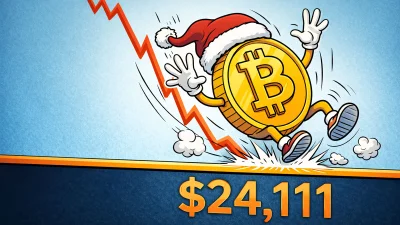
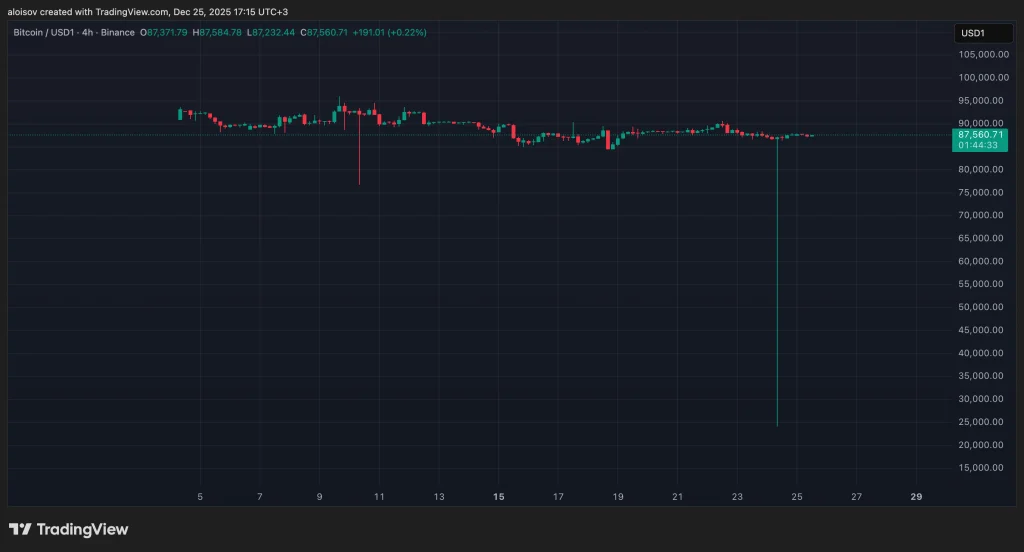
Bitcoin experienced a brief but dramatic price dislocation on Binance on Christmas Day, momentarily trading as low as $24,111 against the newly launched USD1 stablecoin before rapidly rebounding to around $87,000 within seconds.
The incident was highly isolated, affecting only the BTC/USD1 trading pair on Binance. Major bitcoin pairs such as BTC/USDT and BTC/USD continued to trade normally throughout the episode, indicating that the move was not reflective of broader market conditions.
Thin Holiday Liquidity Triggers Flash Move
Market participants pointed to exceptionally thin liquidity as the primary cause of the sudden drop. December 25 is typically characterised by reduced institutional participation, with many trading desks closed and market makers operating at minimal capacity.
USD1, a relatively new stablecoin, currently has a market capitalisation of approximately $2.89 billion, making it the seventh-largest stablecoin globally. However, as a newer asset, its trading pairs generally feature shallower order books and fewer active liquidity providers.
According to analysts, a single large sell order in the BTC/USD1 pair likely consumed available buy-side liquidity, forcing the price sharply lower until a resting bid absorbed the flow. Arbitrage algorithms then rapidly corrected the price discrepancy.
Experts: A Liquidity Event, Not a Market Signal
“Many spot investors found themselves in essentially the same position they were in before the flash crash,” said Nic Puckrin, crypto analyst and co-founder of The Coin Bureau.
Puckrin added that the incident underscores the risks of excessive leverage in markets with fluctuating liquidity, particularly during periods of low participation and heightened geopolitical uncertainty.
Flash candles of this nature are typically associated with liquidity gaps rather than systemic stress. With fewer participants willing to absorb order flow, price movements can become exaggerated until equilibrium is restored.
USD1 Growth and Binance Integration
The episode comes amid rapid expansion of the USD1 ecosystem, a stablecoin launched by World Liberty Financial, a project backed by members of the Trump family.
Earlier this month, Binance introduced an incentive programme offering up to 20% annualised returns on flexible USD1 deposits exceeding $50,000. The promotion is scheduled to run until January 23, 2026.
On December 11, Binance expanded USD1 support by adding fee-free trading pairs for major cryptocurrencies and announced plans to convert collateral backing its legacy stablecoin BUSD into USD1 at a 1:1 ratio.
USD1 was also used in $2 billion investment settlements by MGX into Binance earlier this year, a transaction publicly referenced by Eric Trump during the Token2049 conference in Dubai.
Unresolved Questions
Despite its rapid adoption, questions remain regarding the relationship between Binance and World Liberty Financial. A July 2025 report by Bloomberg, citing anonymous sources, alleged that Binance had contributed to portions of USD1’s codebase.
Binance founder Changpeng Zhao denied the claims, stating that the report contained factual inaccuracies and suggesting potential legal action.
For now, the Christmas flash crash appears to be a textbook liquidity anomaly — a reminder that even the largest crypto exchanges are not immune to extreme price moves when markets thin out.
-
 Ruble-Linked Stablecoin A7A5 Outpaces USDT and USDC in GrowthCrypto & Digital Assets
 -
Crypto Trading Volume Hits All-Time High in 2025Crypto & Digital Assets
-
Coinbase Outlook 2026: Why Ethereum and Solana Are DivergingCrypto & Digital Assets
-
Bitcoin Selling Pressure Intensifies Even as Bulls Eye Higher LevelsCrypto & Digital Assets
-
Binance Quietly Prepares Tokenized Stock Trading ComebackCrypto & Digital Assets
-
BlackRock: Stablecoins Are Now a Core Part of the Global Financial SystemCrypto & Digital Assets