Gold at 10,000 USD? Saxo Bank Lays Out Extreme “What If” Scenarios for 2026
Saxo Bank’s annual Outrageous Predictions outline extreme but plausible 2026 scenarios — from AI-led corporations and quantum security shocks to gold at $10,000 an ounce.
 Olivia Carter
Saxo Bank has released its annual Outrageous Predictions report, outlining a series of low-probability but high-impact scenarios that could reshape global markets in 2026. The publication is not a traditional forecast. Instead, it serves as a set of deliberately provocative thought experiments designed to stress-test investor assumptions and ask a simple question: what if?
Quantum disruption and a surge in gold
One of the most striking scenarios centres on the arrival of a so-called “Quantum Day.” In this thought experiment, quantum computing capabilities suddenly render existing digital security obsolete, compromising encryption across financial systems.
Cryptocurrencies collapse as trust in digital protection evaporates, while gold — an asset that requires no passwords or networks — surges to $10,000 per ounce. Physical vaults, traditional banks and firms developing post-quantum security standards emerge as unexpected winners.
The “Swift effect” and a demographic surprise
Saxo also explores a cultural catalyst: the hypothetical marriage of Taylor Swift and Travis Kelce. The report suggests such a moment could ignite a broader shift away from digital life toward family formation and offline social structures.
In this scenario, global birth rates rebound sharply. Housing, consumer goods and retail benefit, while advertising-driven digital platforms such as Meta and Google face structural pressure. The International Monetary Fund ultimately upgrades global growth projections by more than one percentage point per year.
Political calm in the United States
Another scenario imagines unusually smooth U.S. midterm elections in 2026. With political polarisation easing, investors regain confidence in institutional stability.
As trust in social media erodes — driven by AI-generated disinformation and deepfakes — long-dated U.S. Treasury yields fall, while mega-cap technology stocks lose some of their valuation premium.
GLP-1 drugs and the space economy
Saxo also looks at structural shifts in health care and industry. Widespread adoption of GLP-1 obesity treatments transforms not only human medicine but veterinary care, with weight-management drugs for pets becoming mainstream.
At the same time, SpaceX is imagined to go public at a valuation above $1 trillion, accelerating the emergence of a space-based economy. Semiconductor manufacturing, biopharma research and even commercial lunar land sales move from theory to early reality.
Artificial intelligence in the C-suite
In one of the report’s most debated scenarios, an artificial intelligence system is appointed as chief executive of a Fortune 500 company. The experiment proves successful, delivering higher margins and faster decision-making.
Competitors quickly follow, triggering a broader reassessment of corporate governance, accountability and the future role of human leadership.
China, gold and the future of the dollar
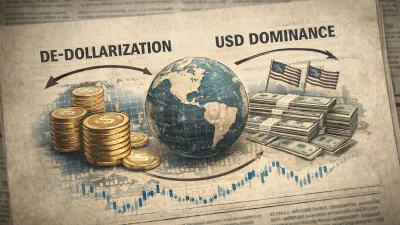
Geopolitically, Saxo outlines a scenario in which China expands its gold reserves beyond those of the United States and partially links its offshore yuan to gold.
Gold prices rise above $6,000 per ounce, while the U.S. dollar’s share of global reserves declines by roughly one-third, accelerating the shift toward a more multipolar monetary system.
An AI system failure
The most sobering scenario involves a large-scale malfunction of autonomous AI agents. Financial markets plunge amid faulty reporting, automated trading errors and real-world accidents involving robots.
The cleanup costs run into the trillions, and a new profession emerges: elite AI auditors tasked with monitoring, correcting and “cleaning up” complex machine-driven systems.
From an editorial perspective, the significance of Saxo Bank’s Outrageous Predictions lies not in their likelihood, but in their ability to expose blind spots. History shows that markets are often disrupted not by consensus risks, but by events few are willing to model in advance.
-
 US Data Center Investment Triples in Three Years as AI Drives Economic GrowthMacroeconomy
 -
Global Billionaire Count Hits Record 2,919 as Wealth Soars to $15.8 Trillion—UBSMacroeconomy
-
Infrastructure Is Massively Undervalued Compared to Global Equities, BlackRock FindsMacroeconomy
-
Musk: AI Could End the U.S. Debt Crisis in Three YearsMacroeconomy
-
De-Dollarization Meets Crypto — Coinbase Explains the Stablecoin ParadoxMacroeconomy
-
BlackRock Sees AI as the Biggest Driver of U.S. Stocks Next YearMacroeconomy