Musk: AI Could End the U.S. Debt Crisis in Three Years
Elon Musk says AI and robotics are the only way to solve America’s $38 trillion debt crisis, predicting productivity will outpace inflation within three years and eventually make work optional.
 Olivia Carter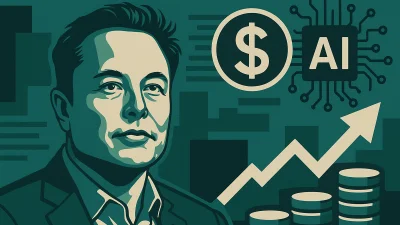
Elon Musk believes the United States has only one viable path out of its rapidly expanding debt burden: a productivity revolution driven by artificial intelligence and robotics.
Speaking in a newly published conversation with investor Nikhil Kamath, Musk argued that the scale of America’s fiscal challenges requires a structural economic shift, not incremental policy changes. The national debt reached $38.34 trillion in late November — more than double its level a decade ago, according to U.S. Treasury data.
“AI and robotics are pretty much the only thing that’s going to solve for the U.S. debt crisis,” Musk said. “It probably would cause significant deflation.”
Musk’s view is grounded in the belief that AI-driven productivity will soon outpace inflation. According to his forecast, the U.S. could reach that inflection point within three years, marking the first time AI contributes more to economic output than to consumer price pressures.
A Future Where Work Becomes Optional
Musk said the long-term impact of AI and robotics will be profound, leading humanity to what he calls “universal high income” — a world in which goods and services are so abundant that people no longer need to work to meet their basic needs.
He expects this shift to occur within the next two decades, driven by exponential gains in autonomous production. In earlier remarks, Musk said Tesla’s Optimus humanoid robot could eventually eliminate poverty and reduce the need for human labor entirely.
“There’s actually only one way to eliminate poverty and give everyone excellent medical care, and that’s with the Optimus robot,” Musk said at a Tesla shareholder event.
The CEO has repeatedly positioned Optimus as a cornerstone of Tesla’s long-term economic thesis — a platform capable of generating massive productivity without proportional labor costs.
“Money Will Stop Being Relevant”
Musk has also floated a more radical scenario: the erosion of traditional currency as a meaningful concept in a hyper-automated economy. Speaking at the U.S.–Saudi Investment Forum, he suggested that as AI scales production, scarcity shifts away from labor and capital and toward physical constraints.
“There will still be constraints on power and mass,” Musk said. “But at some point currency becomes irrelevant.”
While economists have long debated how technological progress could shorten the workweek — a view expressed famously by Keynes in 1930 — Musk envisions something more sweeping: near-total automation of production and a redefinition of economic value itself.
A Highly Uncertain, Highly Transformative Outlook
From an editorial perspective, the significance lies in the contrast between Musk’s vision and traditional macroeconomic frameworks. His forecast hinges on AI accelerating faster than regulators, institutions and labor markets can adapt — while simultaneously preventing destabilizing inflation or inequality.
Whether AI-driven productivity can scale fast enough to influence the U.S. debt trajectory remains debated. But Musk’s comments underscore a growing view among technologists: the next economic cycle may be defined less by monetary policy and more by the pace of automation.
-
 Gold at 10,000 USD? Saxo Bank Lays Out Extreme “What If” Scenarios for 2026Macroeconomy
 -
BlackRock Sees AI as the Biggest Driver of U.S. Stocks Next YearMacroeconomy
-
Infrastructure Is Massively Undervalued Compared to Global Equities, BlackRock FindsMacroeconomy
-
US Data Center Investment Triples in Three Years as AI Drives Economic GrowthMacroeconomy
-
London Masks a Deep Economic Divide Inside the UKMacroeconomy
-
Global Billionaire Count Hits Record 2,919 as Wealth Soars to $15.8 Trillion—UBSMacroeconomy